Old Version
Outside In

Steppe Lively

A trip to the grasslands and deserts of Inner Mongolia offers yurts, camels and adventure tourism, as well as an insight into nomadic culture, just hours from Beijing

By Leila Hashemi Updated Jun.1

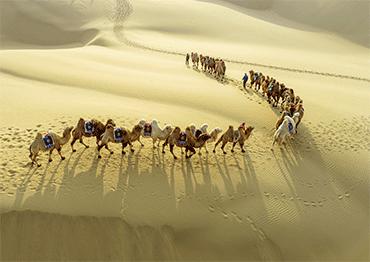
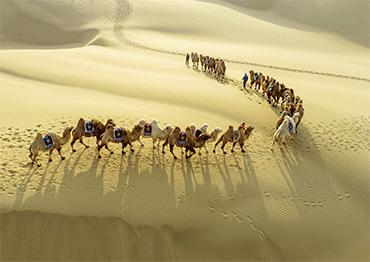
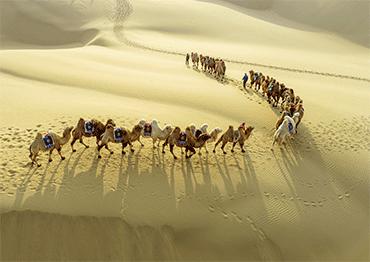
A camel caravan walksin the Kubuqi Desert, Inner Mongolia Autonomous Region, November 29, 2021 (Photo by VCG)

My curiosity about Inner Mongolia Autonomous Region started on a painfully primitive bus ride to Mongolia back in 2016. Somewhere along the way, we passed through the region, and I was completely transfixed. I knew I wanted to come back to find out about what nomadic life on the grasslands and deserts was really like. Plus, as a scenery junkie, a big draw for me is that within a few hours' drive, the lush green hills of the Xilamuren Grassland shift into the rolling sand dunes of the Kubuqi Desert. 

Before Inner Mongolia became a tourist hotspot, these wandering tribes shaped a way of life rooted in resilience and a deep connection to the land. Families moved with their herds as the seasons changed, always in search of fresh grazing land. Their meals were simple but hearty, centered around mutton and dairy. 

Life on the steppe followed these traditions for thousands of years, but you can still catch glimpses of that nomadic culture today. So when two of my friends told me they were coming to China, I knew exactly where to take them. 

While I usually prefer to plan my own trips, this time I opted for a tour. It made reaching the more remote region much easier. 

We realized quickly that this tour was built for students because instead of taking the two and half hour high-speed train we were venturing to the grasslands eight hours away in a long-haul bus. Stop by stop, more passengers got on, one seemingly younger than the next. By the end, there were around 40 of us. 

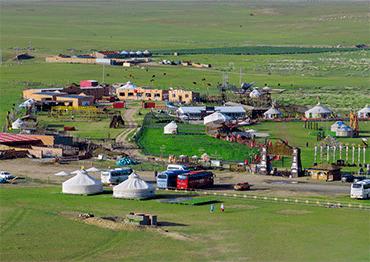
It was dark before we finally reached Xilamuren Grassland. But when we saw the white yurts lit up against a star-strewn black-blue sky, I got a burst of energy. 

Ushered off the bus, we were assigned our yurts. They were bare bones, but still homey nonetheless. In the past, these circular, collapsible homes were engineered to be packed and moved in hours, serving as the essential anchor for a life on the go. Now they are stationary and clustered across an open field. 

It was much colder out on the grasslands than it had been in Beijing, so we threw on extra layers and headed to dinner. That night, we had Mongolian hotpot, a simpler, more traditional style that focuses on the quality of the meat rather than the broth. 

The table quickly filled with plate after plate of paper-thin sliced lamb, along with greens, tofu and noodles. Since I am a hot pot pro at this point, I focused on helping my friends learn how to cook the meat and make the best possible dipping sauce. 

When dinner was winding down, performers poured into the dining area and made their way around the tables. They were dressed in traditional Mongolian clothing, with long, brightly colored robes tied at the waist with wide belts, paired with colorful boots and structured hats. 

They stopped at each table, singing, playing instruments and interacting with guests as they went. 

The performances centered on the "three treasures" of Mongolian culture: throat singing, the horsehead fiddle and traditional dance. Full and fully entertained, we headed back to the yurts to get some sleep after dinner.

Dune-tastic Scenes
The next morning, we piled back onto the bus and headed a few hours out toward the Kubuqi Desert. It was almost eerie to watch the landscape change in real time, with the wide green grasslands slowly fading into rolling mountains of sand. At one point, I genuinely felt like I had stepped onto the set of Dune. 

Though it was incredibly windy at the activity area, there was no shortage of things to do. We started with zip lining, which sends you gliding across the dunes, suspended high above the sand with nothing but open desert around you. After that, we moved on to ATVs. I started off as the driver because if anyone was going to get me into a wreck in the middle of the desert, it was going to be me. 

But fear overtook me, so I turned over control to my friend. All of a sudden we were flying over dunes, bouncing around and catching air like we knew what we were doing. I'm still not entirely sure how I survived. 

After that, we lined up for camel rides. Getting onto the camels was an experience in itself. You climb on while they're sitting down, and then they stand up in two quick, lurching motions, back legs first, then front, which feels a lot less stable than you'd hope. Once you're up, though, they move slowly and steadily, following each other in a line like they've done it a thousand times before. 

My favorite part of the day, though, ended up being sand sledding. You hike up a dune, sit down on a small sled and slide straight back down, picking up speed as you go. It's simple, slightly chaotic, and way more fun than it should be. 

By the time we were done, we were completely covered in sand and more than ready to head back. That evening, we returned to our resort for dinner, where we were served traditional Mongolian dishes, including freshly grilled lamb skewers. I love lamb, but I have to admit, it was a little strange enjoying it while the fields they came from were sitting just beyond us. 

That night, everyone gathered in the main hall, which, importantly, had heat, something our yurts did not. There was free beer and karaoke. But, by the end of the night, some of the songs started to sound suspiciously close to Mongolian throat singing.

Home on the Range
For our final morning, we were split into groups for horseback riding. The range of experience was clear right away, from people who had never been on a horse to those who seemed to be certified horse whisperers. As we moved across the grasslands, the landscape opened up into rolling hills, scattered barns and small enclosures for the horses. We crossed shallow creeks and followed winding paths, with warm sun breaking the cool breeze. 

Near the end, we hit a long, open stretch leading back to the starting point. The guide picked up speed, and the rest of the horses followed. Within seconds, we were galloping across the open land with the crisp air leaving our cheeks red and chapped. 

If you have the time, there's more to explore beyond the main highlights, from the Dazhao Temple to cultural sites such as Inner Mongolia Museum, along with quieter villages that give a better sense of life on the grasslands. It is the perfect destination for nature lovers, adventure travelers and culture seekers alike. 

From the legacy of Genghis Khan and the nomadic traditions of the grasslands to racing across sand dunes on an ATV, there are few places in China where the horizon feels as wide or the skies as blue as Inner Mongolia's grasslands and deserts.

Xilamuren Grassland, Inner Mongolia Autonomous Region, July 13, 2023 (Photo by VCG)

Print