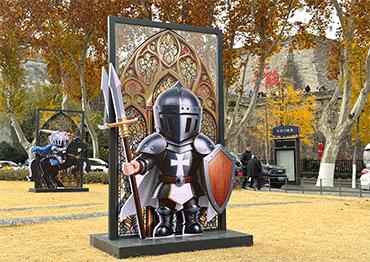
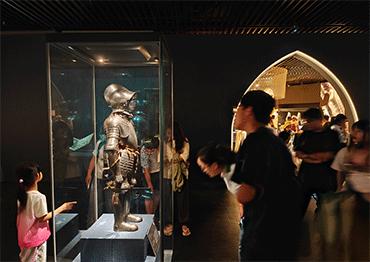
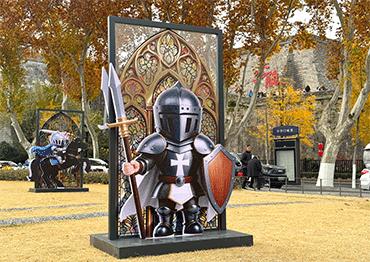
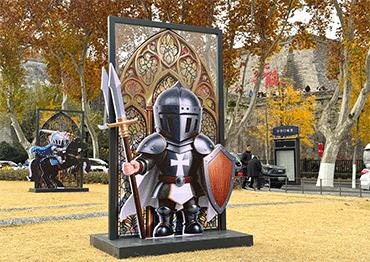
ince March 2025, exhibition Steel of Glory: A Knight's Life of Armor, Blade and Honor has been touring museums in China. The collection comes from the Royal Museums of Turin, Italy, some of which is being displayed outside Italy for the first time.
The exhibition is part of celebrations marking the 55th anniversary of the establishment of diplomatic relations between China and Italy in 1970. A series of cultural events has been staged in both countries since early 2025, including art exhibitions and film screenings.
For more than 2,000 years, China and Italy have been linked by the Silk Road. As a key point along the ancient route, Gansu Province was chosen as the second stop of the European knight exhibition, which was on display at Gansu Provincial Museum in Lanzhou for four months until November 8. It was also the first time a European museum has staged an exhibition in Gansu.
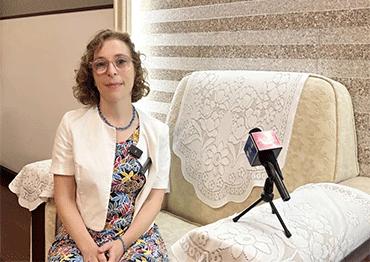
In an interview with China News Service in Lanzhou, Giorgia Corso, curator of the Royal Armoury at the Musei Reali Torino (Royal Museums of Turin), talked about the exhibition’s highlights and discussed the similarities and differences between Chinese and Italian cultural heritage and the exhibition’s importance for cultural exchange.
An art historian, Corso works on research projects, restorations and international collaborations. Her academic focus ranges from medieval and modern art history to book illumination and the history of ancient weapons.
China News Service: What was the initial concept and curatorial approach behind the exhibition, and which cities in China will it visit this year?
Giorgia Corso: Knights emerged during the turbulent Middle Ages, evolving from military vassals in feudal territories into a military noble class with its own unique culture and values. They fought on battlefields and competed for glory in tournaments. From classical antiquity to the Middle Ages, from the Renaissance to the modern era, the knight system left a profound imprint on Europe’s military, political and cultural spheres. Together with my colleagues, we curated the Steel of Glory: A Knight's Life of Armor, Blade and Honor exhibition to show Chinese audiences the development trajectory and cultural charm of the European knight system and material culture.
The exhibition features 140 stunning pieces of European knight armor, helmets, cuirasses, shields and weapons. It is divided into four sections: “Forging the Self: Knight Armament,” “The Road to Glory: The Knight’s Career,” “The Twilight of the Knight: Challenges in Modern Times” and “A Splendid Farewell: From Warriors to Symbols.” The exhibition offers a comprehensive view of the knight system’s development across over a thousand years of history. It serves as an important window for audiences to understand the evolution of European society from the Middle Ages to modern times.
The exhibition was held from March 21 to June 22, at Shenzhen Nanshan Museum [in Guangdong Province]. From July 8 to November 8, it [was] in Lanzhou, Gansu. This was the first time a European museum has hosted an exhibition on the ancient Silk Road. [It is currently being held] in Nanjing through April 15, 2026, and will go on to Chengdu, Sichuan Province.
CNS: Both Gansu and Italy were important points along the ancient Silk Road. What exhibits best reflect exchanges between the East and West?
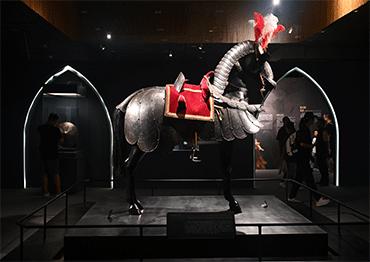
GC: The exhibition features very valuable artifacts, such as a complete set of knight and horse armor, which has left the Royal Armoury for the first time in 200 years to be displayed overseas. We also have a rare set of children’s armor and a helmet sculpted into the shape of a fantastical animal, which dates back to the Renaissance period. It’s an honor and a pleasure to share our collection with Chinese audiences. Visitors can immerse themselves in the experience of wearing knight armor and holding swords.
One particular exhibit, the armor of a noble Italian knight, features a dragon image, which has a different meaning in Chinese culture. In many European legends, dragons, “imported from China,” appear as fantastical, often menacing figures, but not in this case. Here, the craftsmen used the dragon as a symbol of the knight’s family and as oriental aesthetic elements to the design.
Also worthy of special attention are the stirrups on display. This invention, which changed the way European cavalry fought, originated from Chinese steel smelting technology and was transmitted to Europe by the nomadic peoples of the steppes. These exhibits clearly show the signs of exchange between East and West.
The exhibition also presents many works on paper: drawings, engravings, printed books and manuscripts. They recount the life and culture of knights through words and images. We must not forget that paper is also a Chinese invention and that the replacement of parchment with paper for the production of printed books was crucial to the development and spread of Western culture.
CNS: What are your impressions of Chinese museums? How do they compare to Western museums?
GC: I arrived in Shenzhen in March [2025], which was my first visit to China, and Gansu was my second stop. I visited Shenzhen Museum, Gansu Provincial Museum and Dunhuang Museum. My most direct impression is that there are many people, especially children. The number of visitors is huge, and they are very relaxed, happy and comfortable. I was deeply impressed. I really like the creative exhibitions and design in Chinese museums.
Many museums also have multimedia tools that allow visitors to interact and participate, which is very popular with the public and is also present, to a lesser extent, in many Italian museums. In Chinese museums, I appreciated the wealth of content, presented in a creative and original way.
When I visited Gansu Provincial Museum and Dunhuang Museum, I found similarities with Italy. These similarities are seen in the intersection of writing, religion and language, which I find fascinating.
For example, the exhibitions at the Dunhuang Grottoes reminded me of the UNESCO World Heritage Site in Italy known as Sacri Monti (Sacred Mountains), built 500 years ago in the Alps in northern Italy. These are groups of chapels built in a natural setting and enriched with paintings and sculptures that tell sacred stories. People could enter them to pray and worship the images. Compared to the Dunhuang Grottoes, beyond the different cultures and dates, I found the same charm in places created for worship in an inaccessible environment. There are similarities in the painting styles, decorative motifs and techniques used to create the objects. The conservation issues and restoration difficulties are also similar.
Some of the decorative motifs in the Dunhuang murals are strikingly similar to the mosaic designs in St Mark’s Basilica in Venice. This is not surprising, as Venice was the city where trade with the East was most frequent and extensive. Many Venetian monuments and works of art are influenced by Asian artistic cultures.
CNS: This year marks the 55th anniversary of diplomatic relations between China and Italy. What significance does this exhibition have for promoting cultural exchange? Can it offer new insights into how Silk Road culture continues today?
GC: As with our exhibition, we’re not just showing artifacts. We’re telling the stories behind European knight culture, allowing more Chinese audiences to learn about knight culture and Italy. Of course, this is reciprocal. The exhibition also helps us learn more about China and the Silk Road.
Both Venice and Dunhuang have historical similarities in cultural exchange. In the 14th century, Marco Polo from Venice established the link between Italy and China. In 2018, the Pearl of the Silk Road: Dunhuang Grotto Art exhibition was held at the University of Venice, and such exchanges have brought us closer together.
Choosing Gansu as a key stop for this exhibition is especially meaningful. Gansu is a crucial point on the ancient Silk Road, while Italy is the western terminus. When European knight armor is displayed in Gansu, we seem to witness the continuation of dialogues between Eastern and Western civilizations. The artifacts that reflect East-West technological exchanges in the exhibition are the best testament to the spirit of the Silk Road.
I believe that such exhibitions will increase, allowing us to understand each other more and get closer. This exhibition is just the beginning. We also look forward to inviting Chinese art exhibits to Italy, allowing more European audiences to appreciate the charm of Eastern culture.
CNS: What further areas of exchange can Italy and China explore?
GC: I believe that archaeological heritage offers many topics of common interest. For example, we could discuss the importance of the ancient Mediterranean Sea as an area of circulation and exchange between different civilizations. This could be compared with similar geographical realities in China’s territory and history. Another topic could be a comparative presentation of artistic techniques that developed uniquely in the East and West, such as ceramics and metalworking. Another theme could be the value of writing and its crucial role in society and art. Finally, the history of the ruling dynasties, alongside a comparison of life at court and the promotion of the arts, is a topic that may arouse great curiosity. However, these are just a few ideas. A more in-depth reflection based on knowledge of the respective heritages will certainly generate original and stimulating ideas.
 Old Version