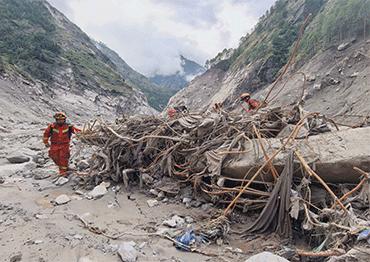
At least 43 people are confirmed dead and 519 are still missing after an enormous debris-filled mudslide hit Gyirong Port on the China-Nepal border in Southwest China's Xizang Autonomous Region on August 26, according to official Chinese data as of September 5.
The catastrophic mudslide was triggered by a large-scale ice-rock avalanche at an altitude of 5,200 meters on the northern slope of Langtang Lirung Peak in Nepal, which caused an enormous flow of ice-rock debris to rush down the valley, evolving into a mud-rock flow with a high speed of about 50 meters per second, according to experts.
The mudslide flattened buildings at Gyirong Port, a crucial channel for transportation and trade between China and Nepal, damaged border roads, cut off power and communication links, and raised risks of barrier-lake formation downstream. Nepal has reported over 1,300 fatalities and thousands missing from the same disaster, after multiple towns and villages were inundated, as well as construction projects.
China immediately activated a top-level emergency response and dispatched troops, armed police and fire-rescue teams in a round-the-clock search and rescue.
Authorities have relocated endangered residents, monitored secondary geological hazards, and delivered humanitarian supplies. China has also provided emergency materials to Nepal to support its relief efforts.
 Old Version