Old Version
Life

Tomb Idols

Young Chinese people are finding comfort in visiting ancient tombs, projecting their desire and stress in modern life onto the unfulfilled ambitions of long-dead generals, poets and officials

By Ni Wei Updated Sept.1

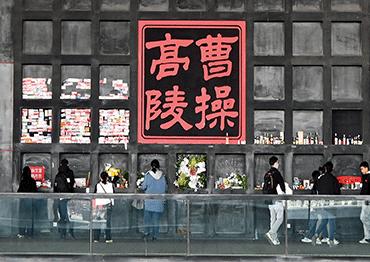
People leave offerings at the Cao Cao Mausoleum Museum in Anyang, Henan Province (Photo by VCG)

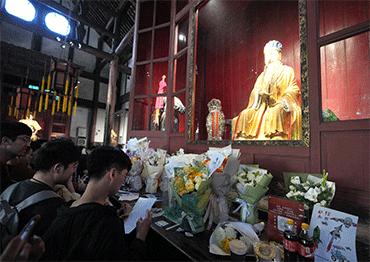
Tourists visit the Hall of Zhuge Liang at the Chengdu Wuhou Shrine Museum in Chengdu, Sichuan Province, April 4, 2026 (Photo by An Yuan from CNS)

Instead of flowers and fruits, visitors to ancient Chinese tombs encounter quirky modern offerings like medications, train tickets and postcards of modern cities. 

At the tomb of Cao Cao (155-220), a powerful warlord and statesman in China's Three Kingdoms period (220- 280) in Anyang, Henan Province, visitors leave ibuprofen and medication tips, referencing his lifelong severe migraines. The grave of Ming Dynasty (1368-1644) prime minister and reformer Zhang Juzheng (1525-1582) is adorned with hemorrhoid ointment, tied to rumors of his fatal post-surgery frailty. 

College students leave snacks for Western Han general Huo Qubing (140- 117), who defeated the nomadic northern Xiongnu armies and died of illness at 23, bonding over a shared youthful spirit. Emperor Xiaowen (467-499), known for his political reforms and Confucianism in his Northern Wei kingdom, is honored with a silk banner and the playful title "Top Sinicization Promoter," celebrating his ethnic assimilation reforms. 

Young people also lightheartedly attempt to remedy supposed historical regrets. For example, a Chengdu-Xi'an train ticket placed on the tomb of Zhuge Liang (181-234), the famed strategist of the Shu Kingdom, acknowledges his failed northern expeditions against the Wei Kingdom, whose capital was near present day Xi'an. Fire extinguishers placed at the grave of Shu Kingdom founder Liu Bei (161-223) reference his crushing defeat in the Battle of the Burning Camps, and Wu state founder Sun Quan (182-252) is mockingly named "Prefect of Hefei," a joke about his repeated failures to seize the city, now capital of Central China's Anhui Province. 

This playful trend has grown popular among Chinese youth in recent years. Using everyday modern items, they connect with historical figures' lives and unfulfilled aspirations through humor, empathy and nostalgia.

Playful Offerings
In March, college senior Yun Que traveled from Beijing to Suzhou, Jiangsu Province to visit the memorial sites of Three Kingdoms (220-280) figures like founder of the Wu state Sun Ce (175- 200). It was already her fifth trip there. She told NewsChina that she brought flowers and postcards, noting that formal sites rule out playful offerings. 

Yun devotes her spare time to paying homage to historical figures. Last summer, she visited over 20 ancient tombs in Luoyang, Henan Province, a region famed for historic burial grounds. Such visits have given a mild boost to cultural tourism, with drivers and guides well-acquainted with tomb locations. 

This hobby is viewed by enthusiasts as a form of offline fandom. They call historical figures "underground idols," celebrities long buried. Today's youth connect with these ancients on a personal level, projecting their feelings about health, emotions and unfulfilled regrets. 

The internet has reshaped perceptions of history. Historical figures are no longer distant textbook characters, but friends to chat with, tease and sympathize with. Many say visiting tombs and memorials brings them joy. "I feel thrilled when I meet an ancient figure I've long admired during my first visit to a tomb. After several visits, I feel like I'm catching up with an old friend," Beijing student Yuan Wenyi told NewsChina. A self-confessed tomb enthusiast, she has traveled to Henan four times over the past six months to pay tribute to ancient figures. 

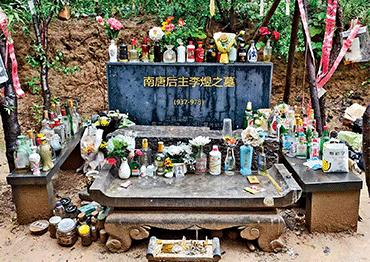
Some fans build private memorial tablets for figures whose real tombs are lost. During this year's Qingming Festival in April, also known as Tomb-Sweeping Festival when people pay their respects to their ancestors, an unofficial monument to Li Yu (937-978), last ruler of the short-lived Southern Tang kingdom and famed poet, drew crowds in Luoyang. Deposed in 975, he was poisoned three years later after being captured by the invading armies of the Song Dynasty (960-1279), leaving behind poems he wrote in captivity. Crowdfunded three years ago online, the tomb's location is based on local lore and not his verified burial site. 

During Spring Festival in February, 20-something Henan local Zhu Qing traveled 200 kilometers from Xinxiang to Luoyang. At the stele (stone tablet) dedicated to Li Yu, she joined a dozen young visitors. They brought flowers, wine and soil from his former capital Nanjing, now capital of East China's Jiangsu Province, to comfort the exiled poet, leaving notes and banners expressing sorrow and fondness. Zhu Qing left postcards of Nanjing and a handwritten note. Banners and cards were hung on peach trees around the stele, bearing lines ranging from melancholy verses to lighthearted slogans. 

Numerous other unofficial folk monuments for ancient literati and scholars exist without official recognition. For visitors, authenticity matters little these sites are simply places to find some peace. 

Art historian Wu Hong told NewsChina that memorials preserve memories, link the living and the deceased and unite communities. Blessed with timeless poems and a tragic life, Li Yu remains immensely popular, embodying why such folk tributes thrive.

Grave Groupies
Fueled by history enthusiasts, tomb visiting has become a rising trend, even at unauthenticated sites. Fans create content and fan fiction centering on historical figures, forming a unique subculture. Visiting tombs acts as an offline form of fandom, providing an outlet to express admiration, respect and empathy. Creative tributes, from handwritten letters to special offerings, have helped more people engage with history. 

Most young visitors are in their "Odyssey Years," a term coined by New York Times columnist David Brooks in 2007 to describe the transitional phase from the late teens to the mid-30s. It has recently resurfaced on Chinese apps, reflecting this uncertain, exploratory period in which young people experiment with careers, relationships and lifestyles. 

Whether inspired by pop culture like anime, fandoms or a passion for history, visits to historical sites ultimately stem from a shared pursuit of inner strength. 

This fandom blends history with modern internet culture. Its members range from high school students to 30-something office workers, with college students making up the majority. The trend of leaving tributes at tombs is largely led by this group, who invented creative rituals such as leaving gifts, banners and notes. 

A great deal of historical fan fiction is built upon these real ancient figures as a form of historical reimagining. Most works focus on portraying friendship, brotherhood or romantic bonds between historical figures. 

Zheng Xiqing, a fan culture scholar at the Chinese Academy of Social Sciences, defines fandom as a cultural community bonded by shared interests, communication and creative output. He notes fan creations grow from personal experience and emotional resonance, making empathy the core of historical fan works, which build freely upon verified historical facts. 

Student Yuan Wenyi believes that mainstream history discussions focus on rulers' accomplishments, while this community's debates revolve around personal admiration for historical figures. 

Fandoms have also driven sales of history-related books and merchandise. A previously obscure two-volume collection of works by Emperor Wen of the Western Wei (535-557) sold 700 copies, selling out in 10 minutes during a livestream session. Many fans have read The Twenty-Four Histories (a collection of histories about Chinese dynasties, last collated in 1775 during the Qing Dynasty) and academic titles to learn more about their favorite figures.

Empathy for the Ancients
Most history fans first fall for ancient literature, then delve into their creators' lives. Zhu Qing adores Li Yu, captivated initially by his poetry and later by his life story. To her, he was a vivid, endearing person, defined by a fate steeped in regret: born a noble prince, forced to be emperor and dying a defeated ruler amid dramatic rises and falls. Offerings of soil and wine from his former homeland reflect visitors' sympathy for his lifelong sorrow and unfulfilled wish to return home. 

Centuries apart, modern people empathize with these figures' struggles. When troubles arise, Zhu Qing looks to Li Yu and feels that his dramatic life makes ordinary worries feel trivial. 

According to Zhu, nearly all beloved historical icons led imperfect, regret-filled lives. Li Yu is celebrated for both his literary talent and tragic downfall, and Huo Qubing for his military genius and early death. Others are admired for failed military or ruling ambitions, their unfinished stories inspire countless fan works. "We're drawn to them because their lives were never perfect," college student Yun Que said. Their stories never reached a satisfying conclusion. Their lives ended prematurely, leaving behind obvious regrets and gaps. Such empathy mirrors modern life: Tangled paths, limited choices and an uncertain future make unfulfilled dreams widely relatable. Many people find emotional comfort in these historical destinies. 

French sociologist Maurice Halbwachs' Cultural Memory Theory states memory is not merely personal, but a social construct shaped by shared values and connections. Young people's tomb visits and fandoms embody this theory. They revive and redefine the collective memories of historical figures, engaging with them through heartfelt emotion. 

The trend has transformed once obscure sites. In late 2025, history enthusiast Jiang Chengyu visited Huo Qubing's tomb in Shaanxi Province, where letters addressed to the "young general" now pile up. Just two years prior, only two bouquets and one card were laid there. The nearby Maoling Museum, where Huo Qubing's grave is located, put 80 of the letters on show, revealing that Huo Qubing is considered a new cultural icon. 

At Zhuge Liang's tomb in Hanzhong, Shaanxi, a young mother shared her hardships balancing childcare and an unfulfilling job. She came to admire Zhuge Liang's perseverance, and asked him to send greetings to her late mother. Many visitors also wrote of setbacks in study and work, drawing inspiration from ancient figures to better themselves. 

These historical icons serve as modern emotional anchors. Fandom for them is one-sided affection: People seek comfort in history and infuse it with their own feelings, with tomb visits becoming a heartfelt ritual. 

Jiang Chengyu told NewsChina he has observed the trend growing since 2024. Even remote, little-known tombs now draw crowds, with travel tips and personal stories widely shared online. He views the movement positively, seeing it as a way for people to show reverence and reconcile the ancients' unfulfilled dreams, like a quiet dialogue with history. 

Many have found peace and strength this way. Upset by family pressure to go on blind dates, student Yun Que visited the tomb of Liu Yuxi (772-842) in Henan. Exiled for decades, the Tang poet remained upbeat and open-minded. Reflecting on his life and listening to locals singing opera nearby calmed and cheered her. "His life was filled with hardships, yet he was renowned for his optimism and open-mindedness," Yun said. 

During stressful exam periods, Yuan Wenyi found solace in poems by Yuan Zhen (779-831), a prominent poet, writer, and statesman of the Tang Dynasty, and Bai Juyi (772-846), another Tang-era poet and official of the Tang. Their perseverance reignited her drive. 

A long-time admirer of Su Shi (1037- 1101) a literati-statesman of the Northern Song Dynasty, Jiang Chengyu draws wisdom from his optimism amid adversity. At the Guihai Stele Forest Museum in Guilin, Guangxi Zhuang Autonomous Region, he saw a stele that was carved to discredit Su Shi and other scholars, who ultimately won lasting respect from history. 

"Life is much the same," he said. "Temporary gains, losses and criticism fade with time, but history delivers the final judgment. This is the greatest lesson historical sites have taught me."

An unofficial tombstone for Li Yu (last ruler of the short-lived Southern Tang kingdom and famed poet) erected by admirers has become a popular spot during Tomb-Sweeping Festival (Photo Courtesy of Yuan Wenyi)

Print