When it comes to ultra-bionic humanoid robots, prioritizing physical attractiveness is an unwritten rule.
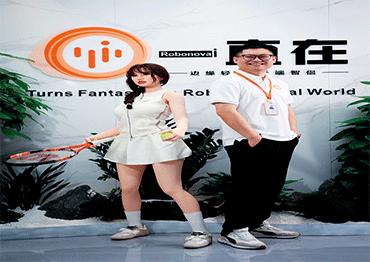
At an office in Shenzhen's Nanshan District, our reporter met Suyan, a female robot developed by Shenzhen Yizhizai Intelligent Technology. Designed for emotional companionship, Suyan is scheduled to be delivered to its first overseas customers in October.
Two Suyan models are displayed in the company's lobby. One sits on a chair wearing a blouse and high heels, while the other stands against the wall in a sporty, casual outfit. Tall and slender, with soft skin and carefully applied makeup, Suyan can be mistaken for a real person from a distance.
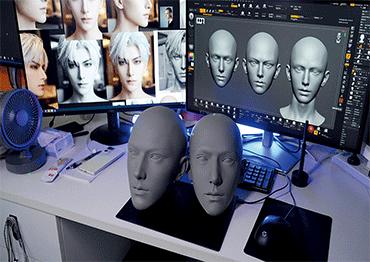
Wu Heng, Yizhizai's founder, told NewsChina that the team's priority is not hardware specifications or movement performance, but how well the robot matches users' vision of an ideal companion. To achieve that, the company analyzed preferred facial features, voices and personalities from users of Chinese and overseas social media platforms.
Suyan targets male and female users between the ages of 35 and 55. According to the company's research, this group prefers a sophisticated, empathetic and emotionally mature female companion. The team aimed to give Suyan an air of affluence and success, while having the calm temperament of a therapist.
This design philosophy differs sharply from that of general-purpose humanoid robots.
"Robots designed for household chores should be completely separate from those created to provide emotional value," Wu said. "The latter must embody mechanical beauty, from aesthetic appeal to graceful body proportions."
"When designing female robots, we consider waist-to-hip ratios. For male robots, we emphasize defined abdominal muscles and a lean physique," he added.
Besides Suyan, Yizhizai is developing two male robots with "domineering CEO" and "idol trainee" personas, both popular archetypes among young Chinese women.
A staple of Chinese romance fiction and dramas, the "domineering CEO" is a wealthy, alpha-male businessman devoted to the female lead. The "idol trainee" is a young aspiring pop singer trained under an entertainment agency while building a close connection with fans.
The company is also developing a female robot modeled as a zoology undergraduate. According to the company, social media research found that both men and women favor the image of a well-educated young woman with a career and a gentle personality. A zoology student, it says, conveys intelligence, professionalism and compassion toward both animals and people.
The robot's bionic skin is also engineered to enhance interaction. When users touch the robot, the contact area gradually warms. Its cheeks can heat to 42 C, mimicking the physiological blush of embarrassment.
China already has a large industry producing lifelike sex dolls, which are legal consumer products. Companion robots introduce a significant difference, however, and the legal and ethical questions surrounding them are only beginning to emerge.
In an April 2025 article published on qq.com, Zhou Chuikun, a lawyer at Beijing Yingke Law Firm, examined some of the potential issues surrounding robots designed for sexual purposes. He noted that sexual activity involving a robot would not constitute prostitution because a robot is not a human providing a sexual service.
That does not mean such interactions would necessarily be legal. Zhou said other laws could apply depending on how the robot was designed or used. A robot made to resemble a minor, for example, could violate laws protecting minors, while robots designed specifically to provide sexual services or remotely controlled to engage in sexual acts could raise issues involving obscene materials and electronic information.
But the bigger legal question may be what these machines are in the eyes of the law.
In a May 2024 article published by the cultural platform Vistopia, Zhai Zhiyong, a professor at Beihang University's School of Law, wrote that Chinese law currently neither prohibits the development of companion robots nor recognizes them as a distinct legal category.
"For now, regulation focuses primarily on safety, while ethical questions remain under observation as society is yet to develop a broader consensus," he wrote.
Zhai noted that lawmakers could theoretically go further, including prohibiting the development of certain companion robots or even banning romantic or sexual relationships between humans and machines. "But such measures would require substantial public support that is not currently evident," he wrote.
In the meantime, the industry's considerations of visual appeal remain a high priority.
On January 30, Shanghai Zhuoyide Robot launched Moya, a bionic robot designed primarily to provide care and companionship for older adults. Unlike Suyan, Moya has pink hair, a round face and deliberately understated features intended to appear warm and approachable rather than conventionally beautiful.
Tang Jun, co-founder and vice president of bipedal products at Zhuoyide, told NewsChina that the team considered creating an "influencer-like" face but ultimately rejected the idea. They worried that overly standardized beauty would feel "too artificial."
Experts say highly realistic appearances are a necessity for authentic humanrobot interaction. "Combining visual and tactile perception creates a more immersive sense of companionship, compensating for the limitations of voice-only AI, which lacks physical presence and expressive feedback," said Liu Wei, director of the Human-Computer Interaction and Cognition Engineering Laboratory at Beijing University of Posts and Telecommunications.
However, designs must strike a delicate balance. "Excessive realism can trigger the uncanny valley effect, in which subtle imperfections in facial features or micro-expressions create a strong sense of discomfort," he added.
In 1970, Japanese roboticist Masahiro Mori proposed the now-famous "uncanny valley" hypothesis. It suggests that once a robot becomes almost human in appearance, even tiny unnatural details can result in feelings of unease, repulsion or even fear.
For more than two decades, researchers and manufacturers have worked to overcome this psychological barrier.
Cao Rongyuan, founder of Wulun Technology, whose company developed a multimodal bionic facial robot called Annie, told NewsChina that subtle natural movements are key.
Functions such as gaze tracking, sustained eye contact and precisely synchronized lip movements all depend on close integration between mechanical design, motion control and interaction algorithms.
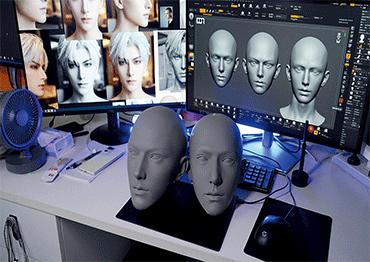
Cao recalled that early versions of Annie could match mouth movements only to a limited set of pre-programmed speech segments. During live conversations, lip movements lagged speech by 200 to 300 milliseconds, far from bridging the uncanny valley.
To solve the problem, the company redesigned the robot's cranial structure to accommodate additional micromotors, enabling more nuanced facial movements such as pouting and pursing the lips. Building on a general lipmotion model, the team then collected Chinese pronunciation data, refined its control algorithms for different mouth shapes and developed a predictive precomputation system. The result was a reduction in lip-sync delay to less than 50 milliseconds, less perceptible to the human eye.
 Old Version