Old Version
Life

Lofty Goals

China’s soccer dreams have endured decades of disappointment. But after a squad of 12-year-olds from an unconventional club defeated some of Europe’s top youth teams, experts are now juggling whether to rewrite the country’s playbook on developing talent

By Wu Jin Updated Oct.1

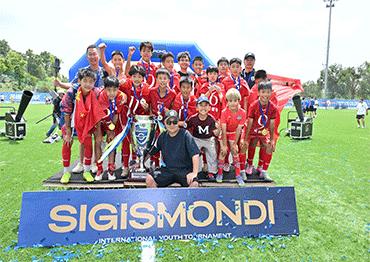
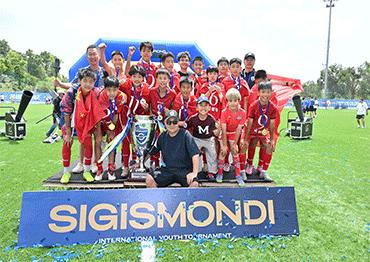
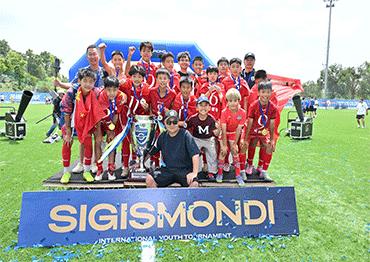
Chinese Football Boy (CFB) head coach Dong Lu poses with his players after their win at the Sigismondi International Youth Cup in Rome,ltalyJune2,2026 (Photo Courtesy of CFB)

When 12-year-old Meng Xinyi of Chinese Football Boy (CFB) club stepped up to the penalty spot on June 2, spectators at Rome's La Borghesiana Sports Center held their breath. 

A goal would seal the Sigismondi Cup, Italy's premier nine-a-side U12 tournament that sees youth teams from top-flight clubs around the world. 

At the referee's whistle, Meng sprinted toward the ball and struck it with the inside of his right foot. The shot curled into the net's top-right corner. Although Everton's youth goalkeeper guessed correctly and stretched to his right, he could only watch the ball fly past him. 

The young Chinese players and their supporters erupted in celebration. CFB had defeated the Everton youth team, from Liverpool, UK, 5-4 on penalties. Overcome with excitement, Meng pulled off his jersey and celebrated with a somersault. 

Led by former sports commentator-turned-head coach Dong Lu, CFB had scored 21 goals and conceded just two for a perfect 7-0 tournament record. 

Even Dong was surprised by their success. "With 48 strong European teams from England, France and Portugal competing, our initial goal was simply to reach the quarterfinals," Dong told NewsChina in July. 

CFB represents hope for Chinese football, which has struggled to score big on the international stage. The country's last World Cup showing was in 2002, where it failed to score a single goal and was eliminated quickly. 

"We entered the tournament mainly to prepare these boys for this year's 2034 Cup," Dong said, referring to the annual U12 tournament he organizes in Suzhou, Jiangsu Province for the 12-year old squads from youth football clubs and schools nationwide. The name "2034" refers to the year Dong hopes China will return to the World Cup finals. 

Founded in 2017, CFB scouts and develops talented players aged 12 and younger. Unlike traditional youth clubs, which are mostly pay-to-play, it provides training with professional coaches and opportunities to compete overseas, largely free of charge. Admission is highly competitive, with players selected through a rigorous, transparent process. 

But CFB's approach of prioritizing skills and match experience over chasing titles has drawn criticism from China's youth soccer establishment, especially surrounding Dong's lack of coaching credentials. CFB's supporters argue that getting to participate in major competitions like Sigismondi, without simply focusing on winning them, is what benefits young players in the long run.

Young Guns
CFB's championship quickly dominated headlines and social media discussions across China. On Sina Weibo, the victory topped the trending list on June 2. 

"Is this how it feels to support a top-flight football team?" a Weibo user from Liaoning Province named Hu Adi commented. 

On June 3, the State-run broadcaster CCTV News shared a 21-second video showing Meng's decisive penalty kick and the team's celebration. The clip got nearly 2.3 million views by July 15. 

The excitement came amid years of disappointment surrounding Chinese soccer. The ranking of the Chinese men's national team has fallen from 53rd in 1993, when FIFA introduced its rankings, to 91st in 2026. In 2025, the team dropped as low as 99th after losing 1-0 to Indonesia, then ranked around 118th in a crucial Asian qualifier for the 2026 FIFA World Cup. 

Plagued by match-fixing scandals, corruption and inadequate training, both the men's national team and the Chinese Super League have struggled to win public trust. 

The team of 12-year-olds has reignited hope among Chinese soccer fans. 

To celebrate the achievement, real estate tycoon and businessman Li Xiaohua hosted a banquet in Beijing on June 27 for Dong and the young players. "I spent a lot on this banquet not only because I admire their championship win, but also because I have been moved by Dong's efforts over the past nine years," Li said at the event. 

This is not the only corporate support CFB has received. 

On July 9, smartphone maker Honor sponsored Dong's club, giving each of its young players one of its flagship phones, according to the Xinhua News Agency. Several days later, beverage company Nongfu Spring extended its sponsorship agreement with CFB from three years to five, according to Zhejiang Daily's Tide News. 

"Previously, none of our sponsorships lasted more than three years," Dong told NewsChina. 
Dong said over the past nine years, player training and international competitions cost 58 million yuan (US$8.6m), a major chunk coming from sponsors like automaker BYD. 

Dong distributed the tournament's 50,000 euro (US$57,100) winnings equally among the 14 players. 

Despite its humble beginnings and criticism over Dong's lack of coaching credentials, CFB has grown from a controversial experiment into a youth training program that has earned rare recognition from mainstream Chinese soccer. 

In its early years, the club had no permanent training ground. Players recruited from schools and clubs across China gathered for intensive sessions on rented pitches only days before competitions. 

A breakthrough came in 2019, when Dong partnered with the Ma Yuehan Athlete Class at Tsinghua University High School in Beijing, allowing around 20 CFB players to train regularly at the school's facilities for four years. 

But the school did not renew the contract. "I was devastated because it felt like all my efforts had disappeared overnight," Dong said. "What consoled me was seeing these players develop." 

More than a dozen have gone on to join club programs in Spain or youth teams in China, such as with Beijing Guo'an. 

Last year, eight of CFB's former players were starters on Beijing's winning U16 men's squad at the 15th National Games, including captain and defensive midfielder Li Dongchen, winger Chen Junhan and forward Zhao Songyuan, who scored the opening goal to defeat Hubei Province 3-1.
 
The Sigismondi Cup was not CFB's first success in Europe. In 2018, the club's U10 squad won the Wide Star Cup finals, a tournament held in Germany organized by Chinese companies Shandong Wide Star Sports and Beijing Lebo Football. Seven of the eight participating teams were European. 

However, the team's 4-1 victory over Germany's Borussia Dortmund U9 squad attracted limited attention. It came during the final years of China's "golden yuan" soccer era, when billions of yuan from real estate companies and other investors fueled overseas projects and heavy spending on foreign players and coaches. 

The investment brought short-term success, including Guangzhou Evergrande Taobao FC's two Asian Football Confederation Champions League titles in 2013 and 2015 under head coaches Marcello Lippi and Luiz Felipe Scolari. But the era was also marred by corruption scandals, match-fixing and misused funds. 

At the time, youth development received far less attention than immediate results. Now, CFB's rise represents a path focused not on buying success, but on developing young players from the ground up.

Contested Plays
Debate over Chinese soccer only intensified after Dong achieved what many professional coaches had struggled to accomplish. 

In an interview with Sina News on June 18, former Chinese soccer star Sun Jihai, a defender for English Premier League club Manchester City from 2002 to 2008, expressed concerns over CFB's frequent participation in international games, arguing that chasing results at the youth level runs counter to proper player development. "It is like growing crops. You need to wait until autumn, not summer, for the harvest," Sun said. 

In 2024, Sun openly recruited young players across the country for his youth soccer club based in Dalian, Liaoning Province aimed at providing equal opportunities for talented players from all backgrounds. The young recruits attend local schools and receive free training and accommodation at the club's base. 

It has nearly 90 players from ages 9 to 13, and focuses on developing fundamental skills such as ball control, dribbling and combination play. 

But Sun's team has yet to win any major tournaments. On February 13 in Guangzhou, Guangdong Province, the club lost 4-0 to Evergrande Football School in the qualifying final of the Universal Youth Cup International Tournament Apuane, losing access to the ensuing games organized in Italy. 

On May 28, its U13 team was eliminated from the provincial qualifiers for the Chinese Youth Football League, a national competition organized by the CFA. 

However, to help each club reach its full potential, the Chinese Football Association (CFA) has introduced regional tournaments alongside provincial qualifiers since 2025. As provincial runnersup, HBK qualified for this year's North Region 1 tournament, where they secured a spot in the national top 32 with six straight wins, scoring 31 goals and conceding just two. 

While Sun continues to emphasize the importance of technical development, Dong holds a contrasting view. 

"Sun is one of the few Chinese players to have competed in both the FIFA World Cup and the English Premier League, so his professional experience naturally shaped his training philosophy," Dong told NewsChina. 

"But his achievements do not mean my experience with game-based training should be dismissed. Over the past few years, I have led CFB teams in more than 1,000 competitions, including over 400 international tournaments. There is no absolutely right or wrong approach. We have simply chosen different paths." 

The debate has also attracted broader attention. On June 9, an article published on the People's Daily website argued that CFB's challenge to conventional youth training should not be dismissed as unconventional or short-sighted. 

"Let's evaluate Dong's training approach rationally and let time determine whether it is scientific and sustainable," the article said. "What we can confirm now is that China should tolerate diverse training models, as long as they are legitimate and follow the rules of children's physical and psychological development." 

It compared the difference in youth training approaches to the relationship between the country's professional Chinese Super League and the local amateur Jiangsu Super League in Jiangsu Province, which has achieved organic commercial success in recent years. While they serve different purposes, they are ultimately complementary. 

"With both, the future of China's football development can be strengthened," the article said.

Game Sense
The 2026 World Cup final on July 20 was memorable for Spain's near-perfect tiki-taka style and Lionel Messi's emotional farewell, but also CFB's Meng Xinyi, who was a flag bearer at the opening ceremony. 

For many Chinese fans, Meng represents a new generation carrying China's World Cup hopes. 
"The Sigismondi Cup victory is already in the past and cannot determine anything about the future," Meng told NewsChina on July 13. "I'll cherish what comes next and continue devoting myself fully to football." 

His ambition is shared by many young players across China. 

Zhou Zhanxu, a 12-year-old student at Changping Middle School affiliated with Tsinghua University in Beijing, wants to become a professional soccer player. His teammate Shi Jian with Beijing Huixin Football Club said he hopes to balance academics and football because he does not want to give up either. 

In June, Huixin FC sent Zhou and Shi to Japan's Nara Club, a division three professional team, for a weeklong exchange training program. Shi said it improved his ability to observe the game, make quick decisions and defend as a central defender. 

"The training atmosphere was excellent. Nobody chatted or got distracted during the sessions, and I improved a lot in that environment," Zhou said. 

While young players remain enthusiastic, their parents are more cautious. 

"A child should grow up with a sport that can stay with him throughout his life," Shi Yiheng, a sports lecturer at Henan University of Engineering and Shi Jian's father, told NewsChina. "But becoming a professional player is another matter, because the odds of becoming a professional athlete are very low." 

"I will support my son entering professional soccer only if he demonstrates not just technical ability but competitiveness as an athlete and continues pursuing his dream every day." 

Zhou Zhanxu's father shares a similar view. "We respect his dream and support his dedication to the sport, but we won't push him to be a professional player," Zhou Hang said. "His health and education are our top priorities." 

According to the head coach and owner of Beijing Huixin FC who spoke to NewsChina using only his surname Chai, China's exam-oriented education system forces many passionate young players to abandon soccer after primary school. 

"But we don't want to simply follow the broader environment," Chai said. "Since 99 percent of the children at our club still want to continue training after primary school, we provide three training sessions and one match every week, just like at Nara Club." 

In February 2024, China's General Administration of Sport issued document on encouraging the expansion of campus soccer programs and training bases. The document set a goal for China's boys' and girls' youth teams in various age groups to reach leading positions in Asia by 2030. 

A year later, the number of registered amateur soccer players aged 21 and under reached 109,220, an increase of 16,241 from the previous year, according to the Chinese Football Association. However, the figure is less than oneseventh of Japan's registered players, the People's Daily reported. 

Following Meng's performance in Italy, his hometown of Nanjing, Jiangsu Province said it would support his overseas training, his father Meng Qinghua told NewsChina. 

"The local government and school promised to preserve Meng's enrollment status if we decide to send him abroad," his father said. "That gives us an important safety net if overseas training does not work out.' 

"Our family discussed this carefully. We know overseas training will be challenging and that standing out will not be easy. But we do not want to let such a valuable opportunity pass without trying."

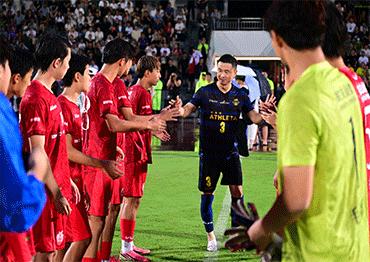
Players line up on the pitch at the 2034 Cup 6th Primary School Students Football Tournament, Suzhou Olympic Sports Center, Suzhou, Jiangsu Province, July 19, 2026 (Photo by VCG)

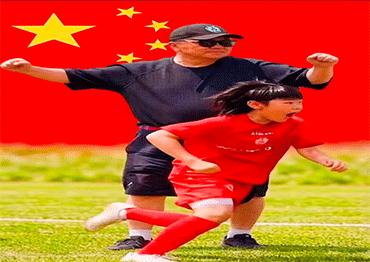
CFB forward Jin Minjun (front) celebrates with head coach Dong Lu after their win against British side Everton in a 5-4 penalty shootout to clinch the Sigismondi International Youth Cup, Rome, Italy, June 2, 2026 (Photo courtesy of CFB)

Print