Nonggang's birdwatching boom began with the discovery of a new species. In 2005, ecologist Jiang Aiwu from Guangxi University's College of Forestry and his supervisor, renowned ornithologist Zhou Fang, found an unknown babbler population in the seasonal rainforest of Nonggang National Nature Reserve. Formally documented and named the Nonggang babbler (Stachyris nonggangensis), it is one of the rare bird species independently discovered, described and named by Chinese ornithologists after 1949.
Located in southwest Guangxi and established in 1979, Nonggang National Nature Reserve covers over 10,000 hectares. It is China's sole protected zone dedicated to seasonal rainforests in its northern tropical limestone region, sheltering rare flora and fauna including white-headed langurs, François' langurs, Nonggang babblers, Parashorea chinensis, an endangered evergreen tree, cycads and golden camellias.
Researchers have recorded vascular plant species and 429 vertebrates, including 66 mammals, 66 reptiles, 31 amphibians and 266 birds, accounting for 36 percent of Guangxi's total bird species. "Out of the 266 documented bird species, only dozens appear regularly. About 10 are really sought-after by birders," Nong Zhengquan, chief of the reserve's Forestry Administration and Resources Protection Section, told NewsChina in early July.
Jiang noted that the Zhuang ethnic group who live in the area possess knowledge that was crucial to finding the Nonggang babbler, and often had their own names for species. "Rangers shared bird descriptions with me - for example, a curved-beaked bird that spends most of its time on the ground,' he said. Nong Weihong, a former ranger, pioneer bird guide and founder of Nonggang's first birdwatching homestay, spoke of a species called "swing bird," named for its hanging treetop nests, which Jiang later identified as the long-tailed broadbill.
After Jiang's research confirmed Nonggang babblers lived in and around Nonggang Reserve, birders from home and abroad flocked there. It led to the development of community-led birdwatching tourism outside the reserve's boundaries.
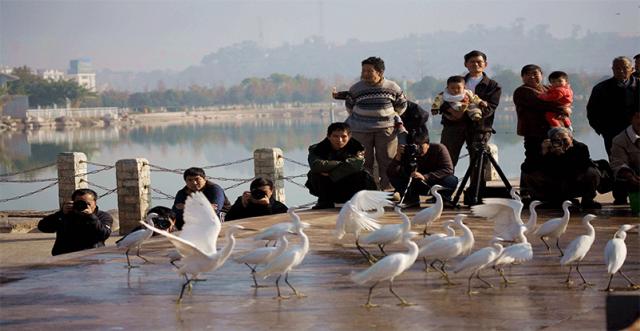
"Liuzhou Birdwatching Society from Guangxi was crucial in the industry's early phase. I first took its members into mountains searching for the Nonggang babbler. Recognizing Nonggang's birdwatching potential, they backed Nong Weihong to convert buildings into visitor accommodation," Jiang said. Around 2015, farmers began building artificial feeding ponds to attract wild birds.
"Nong Weihong created photography hides using kapok blossoms and mealworms. Photographers paid around 80 yuan (US$11.8) each. A single hide could hold over a dozen people, generating steady daily revenue." Jiang said birdwatching has lifted incomes and boosted wildlife conservation awareness. He never anticipated discovering a new bird would transform livelihoods in this remote mountain region.
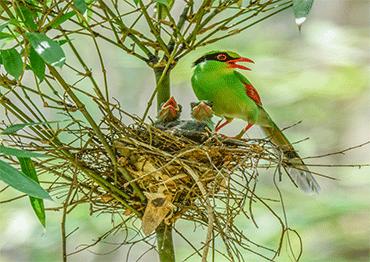
News of the Nonggang babbler rippled across the global birdwatching community. Visitors soon discovered other targets: the Indochinese green magpie, brown-breasted hill partridge, white-browed piculet, blue-backed pitta and long-tailed broadbill.
Huang Zhiqiang started working as a guide around 2008. Before that, his family earned 30,000 yuan (US$4,443) annually growing sugarcane. "I knew nothing about birds. I learned from training sessions hosted by the township government and nature reserve, featuring lectures from invited experts."
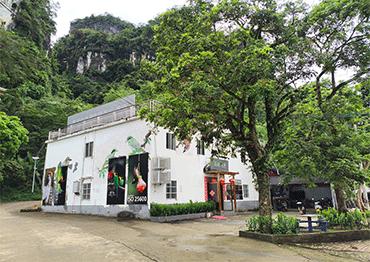
Today he runs Nonggang Bird Lodge, a three-story homestay completed in 2014, which can host 30 guests. Birdwatching has two peak seasons: late September to March for pond photography, and April to late June for the breeding season, ideal for nest shots. During these seasons, Nonggang's 15 homestays are usually fully booked.
Huang Haipeng used to work in neighboring Guangdong Province. Lured by birdwatching opportunities, he returned home around 2014 to become a bird guide. After years of accumulating capital, he invested 800,000 yuan (US$118,500) to open Xiaopeng Inn in 2022. The inn has 14 rooms, and his family manages two ponds known for Indochinese green magpie sightings.
According to Huang Haipeng, combined revenue from homestays, photography hides, transport and guiding brings his family at least 100,000 yuan (US$14,800) annually, far more than his salary in Guangdong.
Local communities have formed clear systems for labor division and profit sharing. Homestay operators provide lodging, meals and transport, while revenue from photography hides belongs to pond owners. During breeding season, if stable nesting sites are located, photography fees are paid to the pond owner who first found the nest.

 Old Version