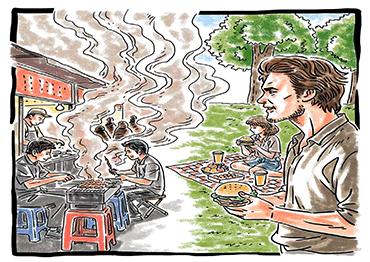
hina demands that its residents are flexible and adaptive. In China one must expect the unexpected and be prepared for daily surprises. Indeed, as an outsider, life in China can seem plagued with inconsistencies, and if I could only use one word to describe my life in China, I would choose the word "contrast." This contrast can be seen in all areas of life in China. For example, I have worked for many decisive and cutthroat business leaders, who prioritize harmony within their business practices. I have heard thumping music stirring passion within many parks and tranquil natural valleys. I have seen countless displays of abundant wealth, combined with acts of humility and the respect for simplicity. Welcome to living in the land of yin and yang.
Yin and yang are concepts in Chinese philosophy used to describe how apparently opposite forces are interconnected and interdependent. Rather than being seen as absolute opposites, yin and yang are understood as complementary qualities that exist in balance and can transform into one another. One of the most obvious areas in which China brings together seeming opposites, is in the convergence of the ancient and the modern. China is simultaneously one of the cradles of humanity and yet sits at the cutting edge of modern technology. If you donate money for incense in a historic temple you are far more likely to use your smartwatch than use cash. If you attend a business lecture from a leading entrepreneur, do not be surprised if they connect their business tactics directly to millennia old philosophies. Indeed, while others might see a battle between the old and the new, many Chinese people would see China's modern success as a direct result of, and inseparable from, its history.
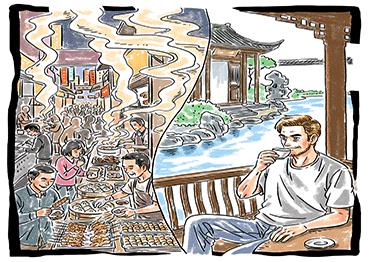
Yin and yang can be seen in almost every area of Chinese life. For example, Chinese society is in many ways defined by its collective approach to decisions and organization. However, it is also true that one cannot escape the individualistic ambition of Chinese citizens in business, education and the workplace. Whereas many nations debate the relative importance of the individual and the collective, China sees the two as being inherently linked. Likewise, China is a land in which human interactions can feel simultaneously formal and highly structured, while being warm and hospitable. If you visit China, you are highly likely to be invited out for a lavish dinner, at the host's expense, where you will be treated with the utmost generosity. However, the dinner will also have a clear seating plan centred around hierarchy, and the generosity of the hosts will be packaged in a formal respect. Another area of seeming contradiction in China is the variation between vibrant energy and serene calm. In China tranquil tea shops and gardens, where the only sound to be heard is trickling water, sit off busy streets that bustle with mayhem. In China people can sit in silence in a meeting or restaurant, yet burst with noise in a theater or a shop.
At its heart, the philosophy of yin and yang is not about conflict, but about balance, interdependence and change. Often symbolized by the famous black-and-white taijitu, yin and yang represent opposite forces that are not enemies, but partners: dark and light, soft and hard, passive and active, feminine and masculine, rest and motion. Crucially, neither side is presented as wholly good or bad, nor can either exist meaningfully without the other.
In terms of the taijitu the yin is the dark swirl, and the yang is the light one. Yang is harder, stronger, brighter, and faster. Yang is the male, but it has a black feminine dot within it. Meanwhile, yin is the darker swirl, the female. Yin is softer, gentler, darker, and slower, however, there is a white masculine dot within its core. Water flowing calmly in a river is yin, but when it cascades over the rapturous waterfall, that same water is now yang. The states of matter, and people, and life itself are not fixed as yin or yang, one can turn into the other.
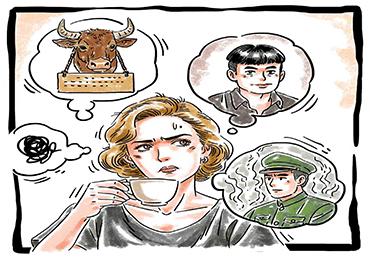
The mistake that foreigners often make when they encounter the curious opposites of Chinese life, is that they see conflict and contradiction, where Chinese people simply see balance. China believes that the yin needs the yang, and the yang needs the yin. Therefore, where a foreigner may see competing concepts as being incompatible, Chinese people may see those contrasting elements as owing their very existence and survival to their partnership.
 Old Version