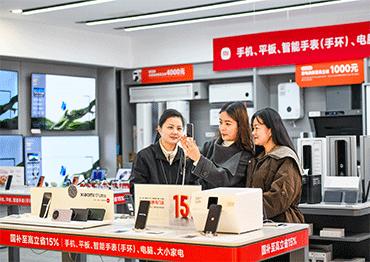
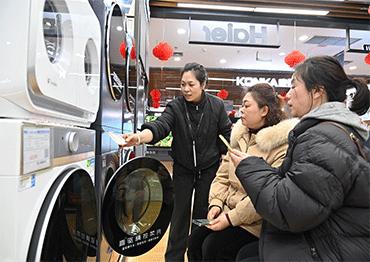
Post-subsidy price inflation has triggered widespread consumer dissatisfaction and undermined public trust in national pro-consumption policies. On Black Cat, a leading consumer complaint platform under Sina China, there were more than 30,000 complaints about subsidy-related price irregularities.
At a year-end press conference in late 2025, a spokesperson from the National Development and Reform Commission (NDRC), China's top economic planner, acknowledged prominent problems in the subsidy program's implementation, including inadequate policy execution, arbitrary price hikes and fraud.
Before that, official audits of 2024 fiscal budgets across 26 provincial-level regions revealed subsidy irregularities and illegal fund utilization in six provinces and municipalities, with the total amount of fraudulent money across the six areas exceeding 100 million yuan (US$14.5m).
An anonymous home appliance industry insider told NewsChina that blatant overpricing above registered benchmarks has become rare due to regulatory oversight. Instead, industry players have ways to conceal their manipulation, such as registering identical products under new model codes to apply for higher benchmark prices.
"Arbitrary price hikes are not the most severe violation," Xu Yingchao, director of the New Crime Defense and Research Department at Jiangsu Guosong Law Firm in Nanjing, Jiangsu Province, told NewsChina. "Some retailers and manufacturers have allegedly faked transactions to siphon off State subsidies, which may constitute a criminal offense."
As seen in provincial audit results, local authorities have referred some serious subsidy fraud cases to judicial agencies for criminal investigation.
The government of Yinjiang Tujia and Miao Autonomous County in Guizhou Province revealed a case where a seller surnamed Wang allegedly stole ID information to fake transaction records, defrauding over 30,000 yuan (US$4,350) from the scheme. The court ruled that Wang was guilty of fraud. He was given a suspended six-month sentence and a fine of 6,000 yuan (US$884).
According to Xu, criminal subsidy fraud has increased rapidly. "Two years ago, only around 10 cases were recorded annually, but lately there've been around three to four new cases almost every month," he said.
"There's an urgent need for improved supervision systems and stricter transaction reviews," he added, calling for more rigorous verification of consumer identity information and transaction credentials to block fraudulent subsidy claims.
Some local authorities have rolled out targeted regulatory measures to plug loopholes. Several provinces such as Shandong have established a dual supervision mechanism combining municipal-level preliminary review and provincial-level inspections, in which prices are checked over several months, as well as orders, transactions and stocks. Others have adopted intelligent supervision tools, such as building digital monitoring platforms, to monitor and trace the whole transaction process of subsidized products.
To standardize pricing behaviors, central authorities launched a unified benchmark price database for all subsidized products, which references merchants' sales records over the previous six months. A standardized punishment mechanism has also been implemented so vendors with three verified violations will be disqualified from the subsidy program and subject to fines.
In a 2026 document on the subsidy scheme, the NDRC pledged to expand the coverage of the subsidy program and conduct a strict crackdown on fraud and price hikes before subsidies.
NDRC spokesperson Li Chao reiterated the commitment at a press conference on June 24. Official data shows that from January to May this year, retail sales of high-efficiency home appliances manufactured by above-designated-size enterprises surged by over 30 percent. The market penetration rate of new energy vehicles in retail sales has exceeded 60 percent for two consecutive months and retail sales of wearable smart devices, newly covered by subsidy policies this year, have doubled year-on-year.
 Old Version