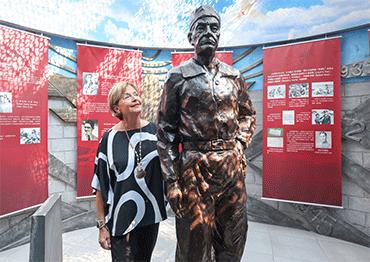
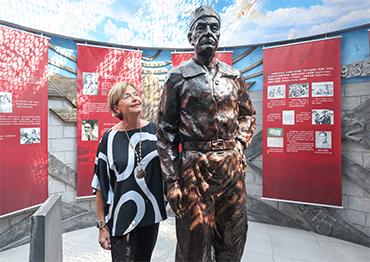
or young Nell Chennault Calloway, General Claire Lee Chennault was just her grandfather, a man devoted to his family. But as she grew older, she began to learn about his heroism.
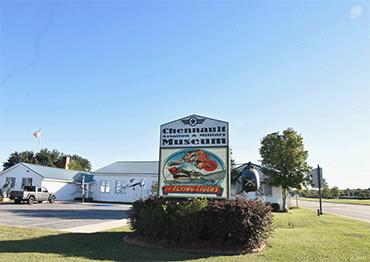
In 2008, 50 years after her grandfather passed away, she became director of the Chennault Aviation & Military Museum in Monroe, Louisiana, where General Chennault grew up and lived after returning from China in the late 1940s. Since 2016, she has served as the museum's president and CEO.
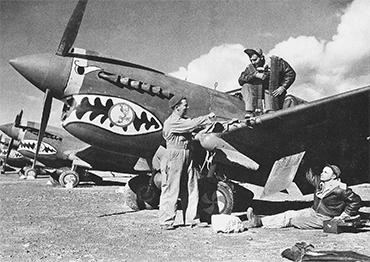
Over the years, she has worked to preserve and share the stories of the Flying Tigers, a squadron of pilots created and led by General Chennault as the American Volunteer Group (AVG) in 1941. Later reorganized as the 14th Air Force, the unit continued fighting Japanese forces in China until the end of WWII.
During this period, more than 2,000 American pilots lost their lives in combat and in dangerous flights over the Himalayas, known as the Hump Route, to deliver supplies from India to China. Many Chinese civilians and soldiers also died while rescuing American pilots whose planes were shot down. The legend of the Flying Tigers remains widely respected in China today.
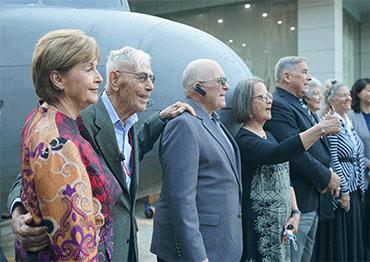
Speaking at the 25th anniversary of the museum in November 2025, Nell Chennault Calloway shared her memories of her grandfather and discussed how the museum continues its mission of promoting peace and understanding between the US, China and beyond.
China News Service: What was your grandfather like?
Nell Chennault Calloway: I was only eight when he passed away [in 1958]. I remember calling him "Granddaddy." I remember coming here to Monroe to visit him on our vacation time. He just never talked about the war. He seemed to take a lot of interest in us. When we went to the house, he would send my parents to have tea with Anna, his Chinese wife, and he would take us into what I called a trophy room because there were a lot of trophies in there. He would sit me on his lap and ask questions about school. Then I remember going to the garden. He would show us vegetables. He loved his garden. I never knew about him flying airplanes until after he passed away. I was in the fourth grade. We had a weekly reader, which was kind of a news magazine for young people. It had a picture of a man in a uniform that looked just like my grandfather. I knew my mother had gone to his funeral only a few weeks before.
I was shocked. I went out and told my teacher, "This looks like my grandfather and they have the same name." She thought I was making it up. Eventually I was very persistent and she called my mother, and my mother did confirm that it was my grandfather.
But I don't think I got quite curious about that because my father had been in the war, and my uncles had been in the war. So somebody else [in my family] having been in the war wasn't as impressive to me at that time until I got much older.
Unfortunately, it probably took going to China for the first time in 2002 that we really heard firsthand what the Japanese had done to Chinese people. My mother (Rosemary Chennault Simrall, 1928-2013, General Chennault's youngest American daughter and founder of the museum) had never known that either.
She was aware of the Flying Tigers, the AVG, but we were not necessarily aware of the horrors the Chinese people [endured] and what they went through, the persecution. How they, for 10 years before the AVG ever got there, carried on as the Japanese tortured, raped them and just were merciless to them. When we heard those stories, the light went on for her why he stayed in China and didn't come home all those years. She was 72 on her first trip to China. Looking back, I wish she could have understood it before she was that age.
We had opened the museum two years before that, so it made us determined when we came back to tell the Chinese story. And so since that first visit, we've been trying to tell the Chinese story here.
CNS: What is the mission of this museum?
NCC: We have a lot of missions. The museum is about past, present and future. We are about the past because we teach the history of our country. We have 12,000 artifacts from our Civil War to present day conflicts. We also have the Chennault Room exhibition, which is a very important historical part of it. Remember the time we put aside differences? We weren't allies before the war started. Because the Japanese attacked China and then attacked the US, we put aside the differences and saw the importance of becoming allies.
Today we can realize that with the nuclear weapons that we have, if we were to have a war, we might not have a world. So we need to figure out how to put aside these nuclear weapons and our differences we have and figure out how to coexist in this world and make it a better world for our future generations.
We are about the present. One of our mottos is we are more than a museum. We provide veterans services, such as post-traumatic stress disorder counsel, clothing, as well as [helping to process] claims and benefits for disabled veterans.
Some museums focus more maybe on the Chinese side or American side. I hope we work hard to tell both sides, and the side, as my grandfather would say, that shows two great peoples working toward a common goal in war and peace.
CNS: What makes the Flying Tigers special, and what lessons can we still learn from them today?
NCC: When [the AVG members] first signed up to go to China, they thought it was going to be a big adventure. They were 19, 20, 21 years old, the oldest just 24. They called my grandpa "old man" [Chennault was 44]. They were all shocked how bad the conditions were when they landed in [what was then] Burma (Myanmar) and India. It was horrible conditions, extremely hot, bugs. They had to sleep under the netting every night. The food was very hard to adjust to. A lot of them had dysentery and picked up a lot of different diseases from the food. But they stayed because there was a bigger cause. It's bigger than your comfort at times. They saw very quickly and early on, like my grandfather did when he got there, that there was a real need for what they could do. That is the lesson that we can learn from them.
As I said [we should learn from their] humanitarian side, they never gave up. Do not look at people as different, look at all people as the same. We all want to live in peace. We all want to raise our children and give them a better life than we have had. That is why men go to war. They see families and they realize they are going to war to make sure that their families continue to have a good life, and inspire people who are willing to sacrifice as they did. They went to a foreign land that we weren't at a war with at the time (the US entered the Pacific War after Japan attacked Pearl Harbor in December 1941) and tried to help them be able to live that way as well.
CNS: Can you tell us about the museum's connection with China?
NCC: A very important connection is the US-China Youth Leadership [program]. It's amazing. They contacted me about five years ago. They contacted us and said they had a group of Chinese students [studying in] Florida, New Jersey, California, all over the country. They came up with the projects for our area we live in, what they call "under-served" because we have a lot of poverty here. They wanted to teach these kids to give back, and their parents wanted to sign on to it as well.
For the first project, they called and said we are going to raise money to buy bicycles and give them away. They said they would buy 40 bicycles. Then they said we've raised enough money for 60 bicycles. Then 100 bicycles. But the thing I was so impressed with is that they bought the bicycles and had them all shipped [to the museum]. Then the students themselves came, put all 100 together, and allowed us to give them away to needy locals.
But there wasn't a lot of interaction with our local students. So [the program] contacted me the next year and asked, "what would you like this year?" I said I really want something like a game. You can really get kids' attention with games. Maybe VR, some kind of simulator that they can fly and maybe do some combat. So they bought us a state-of-the-art flight simulator.
We've got over 40 airplanes programmed in it. They programmed it. There were five students [from the program] that came here and set up the simulator. Then they had a weekend here. We had 15-20 area high school students together. They taught [the local students] about Chennault and about US-China relations, then gave them a test. The first year they gave an iPad Air to the student who scored the highest. That worked out well because there was interaction.
They wanted to know what we would do the next year. I thought VR goggles would be great. So they actually ordered this machine from Germany. It's for physical therapy. But then they programmed VR goggles. It's a game. You put them on, turn it on and you are in a wingsuit, flying over the Hump Route [from India to China] over the Himalaya Mountains to bring supplies in.
The most meaningful part for me was in my office. On the simulators you can only do two at a time, so the rest of the kids [from our area schools] were in my office, just talking about things. One of the kids said, "You know I don't even care about winning." He said, "I had so much fun." Three or four others said "I don't either." [The game] had been really cool, but they had interactions with the Chinese students. I think that was just so beautiful. That was really important.
Interaction is so important because kids here don't have many opportunities with international students. Not every child can go to China. How can we do more to bridge the gap? We have computers now and other means of communication, all the means to let young people communicate with each other. You don't really appreciate the other person unless you get to know the other person. There will be greater appreciation if we could figure out how students can have more interactions with people from other countries.
CNS: Do you think cultural or personal exchanges like these can help improve US-China relations?
NCC: I think this is the only way to help people understand each other. Because news media is not always fair. Media is important. Some people only believe what they read about here. They don't really try to research it out. If you write something and they read what you wrote, they'll go and repeat it, whether it's a fact or not. I think it's very important to have personal exchanges that we see for ourselves.
The bilateral exchanges that I'm talking about right now have a lot to do with younger people. They are the future. They're the ones that are going to be in power eventually and be making the decisions for our world.
[If] I were a Chinese person and had a very good American friend, it would make me see Americans more positively. And the same goes for an American having a very good friend from China. It just really helps to solidify the importance of making sure that we stay friends.
 Old Version