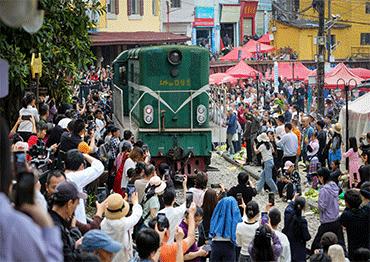
ore than a century after the first rail link between China and Vietnam opened, there has been progress in upgrading the line to once more allow cross-border traffic. On March 25, a Chinese Commerce Ministry delegation handed over draft preliminary feasibility study report for Vietnam's Lao Cai-Hanoi-Haiphong railway project for passenger and freight to Vietnam's Ministry of Construction in Hanoi, according to the Vietnamese government.
In February 2025, the Chinese Foreign Ministry confirmed that the two countries had agreed to accelerate the Mrailway project linking Hekou, adjacent to the China-Vietnam border in Southwest China's Yunnan Province, and Lao Cai in Vietnam across the Honghe (Red) River. On December 19, 2025, the groundbreaking ceremony for the first section of the 390-kilometer Lao Cai- Hanoi-Haiphong standard-gauge railway was held in Lao Cai Province. The US$8.3 billion project is scheduled to complete in 2030, with a design speed of up to 160 kilometers per hour.
The existing line was built more than 120 years ago with a meter-gauge track. More than half the world's railways today use 1,435 mm width tracks, known as standard gauge. Passengers and freight now have to change trains at the border to enter China where standard tracks are adopted.
France, which colonized Vietnam from the late 19th century to mid-20th century, wanted to take advantage of Yunnan's rich mineral resources like tin and copper, as well as China's market for French goods. In 1903, China and France signed an agreement on a French initiative to build the Kunming-Vietnam Railway, which would be owned by France. Construction started the same year. Tens of thousands died during the seven years of arduous and dangerous labor in the mountainous plateau of Yunnan, ranging from around 900 meters to more than 2,000 meters high.
In April 1910, the Yunnan-Vietnam Railway, funded and designed by French colonists and constructed mostly by Chinese labor, went into full operation. Two years later, power generators made by German giant Siemens transported through the line were installed at the Shilongba Power Plant in Kunming, the first hydropower plant in the Chinese mainland. During the Chinese People's War of Resistance against Japanese Aggression (1931-1945), the railway served as a lifeline to transport materials that China desperately needed, even though it was bombed by both the Japanese and Chinese armies. The line was repaired after the war, with operations suspended and resumed in different sections from time to time. High-speed trains between Kunming to Hekou on the border started in 2019, reducing travel time to no more than four hours. A century ago, it took a whole day to reach the border.
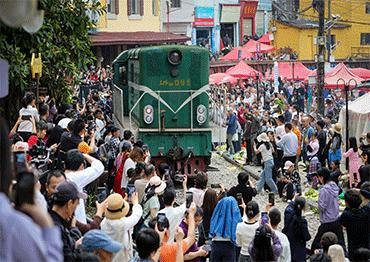
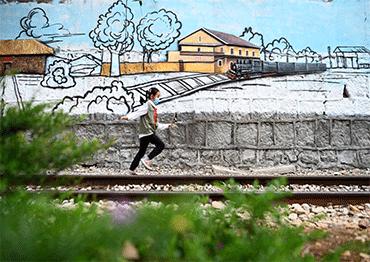
Today, cities along the line are turning the industrial legacy into tourism opportunities. In Kaiyuan, the midpoint of the Yunnan section, tourists can take 40-minute sightseeing trips in retro train carriages on the old meter-gauge track.
For 28 years, Yvon Velot, a member of the World Heritage Institute of Training and Research for the Asia and the Pacific Region under the auspices of UNESCO, and a French foreign trade advisor and representative in Kunming of the French Chamber of Commerce and Industry in China, has collected and studied tens of thousands of historical documents about the Yunnan-Vietnam Railway. He is also founder and general manager of Kunming SinoMekong Company, a consultancy on business and strategy, cultural and industrial heritage, higher education partnerships and educational engineering. At the end of February, 80 years after France handed over ownership of the line to China, Velot, known as Pei Yifeng in Chinese, spoke with China News Service about the industrial and cultural legacy of the railway.
China News Service: Why are you so interested in the history of the Yunnan-Vietnam Railway?
Yvon Velot: In 1999, I was in Kunming for business purposes. At an exhibition of old photos in that year, [there were] a lot of photos taken by the first French Consul-General Auguste François
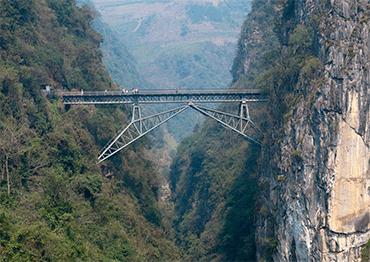
(1857-1935, photographer and French consul in southern China from 1896-1904 and known as Fang Suya in Chinese) in Yunnan. Some of the photos displayed the stunning visual effect and sophisticated mechanical structure of the bridges and tunnels of the railway crossing the mountains and valleys, especially the engineering marvel, the [Wujiazhai] bridge resembling the Chinese character 人 (person). As a mechanical engineer, I was deeply obsessed. Since then, I began to collect and study anything related to this railway. In the past 28 years, I have collected more than 10,000 pieces of precious materials, including photos, glass negatives and topographic maps, and published dozens of research papers.
The Yunnan-Vietnam Railway is the earliest railway built in West China and represents the pinnacle of engineering technology during the French industrializing era. It is also the most visualized testimony of France-China relations. However, this complicated but important history remains obscure among the public of both countries. I hope more people, especially the younger generation, would learn, cherish and guard this cross-border legacy through what I have done.
CNS: Why is the cross-civilization historical industrial legacy of the Yunnan-Vietnam Railway so valuable?
YV: The railway is a marvel in engineering history. It rides through the high and steep mountains of the plateau in Yunnan, and across deep valleys along the rivers of the Jinsha (the upper reaches of Yangtze) and Nanpan. Bridges and tunnels covered two-thirds of the line. The construction was as difficult as that of the Panama and Suez canals. France's best engineering techniques were applied, and the steel materials, equipment and architects were from France. The Wujiazhai bridge over the Nanxi River between two cliffs is the brightest pearl of the project, the paradigm of engineering mechanics, a tussle between human and nature, and most importantly, a living industrial legacy.
But the value of this railway goes far beyond technology. It is a multidimensional cross-civilization historical industrial legacy, a shared legacy. On one hand, it is an early good example of tech transfer, and more importantly a result of cooperation between engineers and laborers from France and China. During this process, a lot of Chinese laborers became technicians or team leaders, laying the technical foundation for China to build railways by itself later. On the other hand, the railway is a symbol of international openness in the early stage of globalization. Photos taken in 1935 show people taking the most advanced Micheline locomotives [rubber-tired trains developed by French rail companies and Michelin] to Kunming, and then taking sedan chairs. This strong convergence of civilization is an epitome of the change of the times.
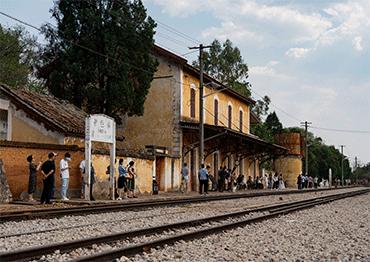
Yunnan's first railway to the outside world, it brought the first hydropower station, the first water pump and the first foreign bank to Yunnan, the province's first exposure to modern industrial civilization. French publications of travelogues in 1911, for example, Un Voyage à Yunnan-fou (Travels around Yunnan) by Georges Cordier, (a writer and director of the French-Yunnan school), allowed the West to learn about the "secret land" of Yunnan. Businesses bustled along the line, and Kaiyuan rose to become an industrial town. Bisezhai station [in Mengzi City], was once known as the "little Paris of the East." Kunming was one of the first Chinese cities with access to electricity. Trains running on this railway, though even slower than automobiles at that time, allowed freight and people flows and accelerated Yunnan's opening up to the outside world.
In 2018, the railway was included in China's industrial legacy conservation list. This should remind us that time would enrich industrial legacies further. The railway does not just carry cold steel rails, but human stories, tech transfers and emotional connection. This is exactly why Yunnan's Pingbian Miao Autonomous County and Tanus, France, across mountains and seas from each other, have been brought together by two bridges designed by the same French engineer Paul Bordin - Wujiazhai Bridge and Viaur Viaduct [built in 1902]. This is the most touching case of how an industrial legacy can serve as a track of dialogues between civilizations.
CNS: In your cross-cultural research on the railway, how do you balance the Chinese and French perspectives?
YV: With its special historical origin, the railway is a unique lens through which contemporary Franco-Chinese relations are interpreted. It is rooted from colonial expansion. This part of history should not be evaded in our research. Any research must be built on our recognition and understanding of the complexity of the history.
From the Chinese perspective, this railway is often also regarded as a window for China to open its eyes to the world, and a symbol for both national humiliation and aspiration for revival. In France, people are more amazed by the engineering marvel and adventurous spirit it represents. This gap in perception results from the different historical experience and collective memories of the people of the two countries.
But history is never based on a single color. For more than a century, this railway has bonded two civilizations, that are far away from each other, closely. The process has been filled with collisions and pain, but also generated unexpected integration and fresh things. What I have been trying to do is build a bridge of mutual understanding and excavate those lively people-to-people exchanges.
For example, French missionaries were the first to introduce wine brewing techniques and coffee samples to Yunnan. Then local wine and coffee industries began to grow here after the Yunnan-Vietnam Railway was opened. Today Yunnan has become one of the major wine production bases and the largest coffee cultivation base in China. Yunnan's Tuo Tea was sold to France where it was well received as a health drink. Yunnan's aromatic herbs have been important ingredients for French perfume. All these trade and cultural ties that still remain today are the other side of the complexity of the history, and provide a realistic foundation to continue its role as a track for dialogues between different cultures.
In fact, contact between Yunnan and France started before the railway arrived. French missionaries came to Yunnan in the early 18th century, and French consulates were established in Mengzi and Kunming by the end of the 19th century. Yunnan had always been at the forefront for France to learn about China. The thousands of photos left by Fang Suya are a precious witness of this long history of interactions.
CNS: What lessons can the Yunnan- Vietnam Railway provide for the world today for connectivity and communication between different civilizations?
YV: Thanks to the maintenance and conservation efforts of China and Vietnam, many original relics of the railway have been preserved, keeping its value as both an industrial legacy and a living cultural legacy. This also inspires us that for connectivity projects, we should think about not only their economic benefits, but also their possible legacies, paying more attention to their long-term cultural value.
I have visited nearly all the important stations along the railway over the years. My efforts on field research, academic forums and exhibitions have led to around 10 exhibitions of old photos of the railway in Kunming, Beijing and Paris.
I also founded a consulting firm to promote cooperation between French and Chinese enterprises and colleges on business, education and cultural legacy preservation, and to facilitate students' exchanges of visits. With my assistance, Pingbian Miao Autonomous County and Tanus have established a friendship. The purpose of all these efforts is allow the history to project onto today's reality.
Today, though the railway [in the Yunnan section] has had its transportation role replaced by modern railways and is left idle, this does not mean it has lost its value. Bisezhai Station has become a tourism attraction as a location for the film Youth (2017, by Feng Xiaogang), and sightseeing trains vroomed again on the meter-gauge rail in Kaiyuan. This century-old artery is being rebuilt as a popular tourism card.
I believe that through scientific planning and conservation, the Yunnan- Vietnam Railway can become a unique world-class tourism and cultural project. I hope that Wujiazhai Bridge would be listed as a world cultural heritage in the future.
The track that used to convey people and cargo should carry ideas, memories and friendship today, and continue to play its indispensable role of ties bringing dialogues between the French and Chinese civilizations, and between Chinese and Southeast Asian civilizations. The Yunnan-Vietnam Railway is not only a testimony of history, but more a bridge of cooperation for the future.
 Old Version