Old Version
Economy

Lean Machines

Local governments are providing incentives and space to attract small, AI-powered companies to drive economic development, while insiders warn of copycat projects and uncertainties over the security risks of smart agents

By Wu Jin , Wang Shihan Updated Jun.1

People in an offfce for OPCs in Zhongguancun AI North Latitude Hub, Beijing, March 13, 2026 (Photo by Wu Jin)

Weeks after China's Spring Festival in mid- February, red lanterns and festive lights still hung on the bare trees and low-rise buildings of a vast sunken plaza situated in the northern Beijing's Haidian District, long known as the capital's science and tech center. 

The exterior obscures the hive of activity inside the terracotta-red plaza, called Zhongguancun AI North Latitude Hub. With a mission to support AI-related startups, the first entrepreneurs, running One Person Companies (OPCs), were invited to the hub in December 2025. 

Following a nationwide surge of AI innovation incubator communities, from AI Industry Park in Suzhou, Jiangsu Province to Zero Cube in Shanghai's Lingang Special Area, Beijing is eager to stay at the forefront of the tech revolution. 

"We can look at these AI innovation incubators open to small startups as a completely new business model, projected to accelerate productivity, transform organizational structures and expand markets beyond the imagination," Ren Chuang, deputy manager of Beijing Zhongguancun Science City Innovation Development Company, who is also in charge of operations at ZGC AI North Latitude Hub, told NewsChina. 

Unlike conventional startups or selfemployed individuals, solo entrepreneurs, known as OPCs, or small teams can see enormous success in the age of AI, which allows them to concentrate on their core businesses and finance without the distraction of mundane office tasks. 

Using only a laptop and an AI toolkit, today's entrepreneurs can develop, market and deliver a product. These are sufficient to run a business that may generate revenues as high as a traditional hierarchical company.

From Dream to Stream
In 2024, OpenAI CEO Sam Altman predicted in an interview with Reddit cofounder Alexis Ohanian for Fortune that AI will enable the creation of the first one-person billion-dollar company. 

That milestone may be reached this year by Michael Gallagher, whose AIaided startup MEDVi, a telehealth provider of weight-loss drugs, is on track to earn US$1.8 billion in sales, according to The New York Times. 

However, there are still many pitfalls, given the high obsolescence rate of AI tools, overlapping business models and young entrepreneurs' lack of astute marketing insight. 

A volunteer teaching stint in a rural school in Shanxi Province, though only for one semester in 2012, was enough to strike a chord with Song Lu, who was about to become a postgrad in educational technology at Beijing University of Posts and Communications. 

"It only had one computer, and the teaching style was incredibly outdated and rigid. The students just recited what they were taught, never mind if they understood it or not," Song, now, the founder of Beijing Wanchui Technology, told NewsChina. 

"So the idea to spread quality education by using cutting-edge technologies started to grow in my mind," she recalled. 

Early this year, she left her role as product manager in an educational company and launched her own business, focusing on providing immersive picture book reading solutions to kindergartens. 

"We target kindergartens as our market segment, after we identified that one of their pain points was how to teach children to read picture books," Song said. They design lesson plans and classroom prompts, and her team launched an interactive role-play function for the children, so they can be protagonists and steer the plots of stories. 

"We're now cooperating with a kindergarten. While I hope my product can spread nationwide, growth takes time," Song said from her office at ZGC AI North Latitude Hub. They use Cursor, an AI-assisted software from San Francisco-based Anysphere to write code, as well as other AI tools to assist revision, proofreading and typesetting. 

"AI tools like Cursor are quick and efficient," she said, "but we don't rely entirely on these tools, treating them like assistants rather than substitutes." 

Song is one of the 54 entrepreneurs to take up residence in the hub by March. The center evaluates candidate companies' core competencies, market potential and AI applications before offering them space. 

"It's different from traditional industrial entry criteria, which focus on enterprises' scales as well as their founders' backgrounds, such as whether they worked at a major Chinese tech giant. The access standards for our hub are much more flexible," Ren said. 

"Entrepreneurs who are proficient in using AI tools and keenly aware of industrial trends and market demand are welcome to our hub. When we interview candidates, we prioritize their applications based on their companies' core values, business solutions and market positioning, rather than annual profits, staff size and tax contributions," he said. 

The country's first area to provide support for AI OPCs in China was launched in Suzhou, Jiangsu Province during the 2025 Jiangsu Artificial Intelligence Innovation and Development Conference and the 1st AI OPC Conference, which convened in November 2025. 

At the conference, Suzhou representatives said the city plans to establish over 30 OPC communities to accommodate 1,000 additional OPC startups and attract over 10,000 OPC talents by 2028. 

In the ensuing months, many major cities in China, including Shanghai, Shenzhen, Guangdong Province, Chengdu, Sichuan Province and Hangzhou, Zhejiang Province, joined the trend of this new form of entrepreneurship that is particularly popular among young people. 

"The average age of the entrepreneurs in our hub is below 30," Ren said. "Young people are better at making use of AI tools." 

Wang Chao, the founder of DeepPaas, an AI+No-Code platform for software development and user interface (UI) designs, told NewsChina that employees at tech giants cannot always give their whole attention to their work, due in large part to inefficient top-down communication. 

Several years ago, Wang, who is now an entrepreneur settled in ZGC AI North Latitude Hub, sold his first self-developed coding platform to a giant tech company, hoping more customers would choose his product. Instead, he found they wanted to capture his traffic, not help Wang develop his business. 

"I expected my code to serve business clients, but the company asked me to be compliant to its strategies," Wang said. 

After resigning, Wang started another business in 2022. Today, with five fulltime and two part-time programmers, he has built a user base of about 50 business clients, including the media platform for some AI and business intelligence (BI) systems of government departments, the portal website of Marriage and Family run by the All-China Women's Federation and a number of chip manufacturers. 

"My next goal is to expand the coding platform among potential individual customers," he said.

Generous Offers
Luo Dizhou, a product director at a high-speed camera company in Shenzhen, said he has no experience in coding. But he recently deployed AI smart agent OpenClaw in his iCloud, integrated with his office software. 

OpenClaw, developed by Austrian "vibe coder" Peter Steinberger, is a free open-source AI virtual assistant based on large language models (LLMs), which performs admin tasks such as sending emails, checking calendars and other tasks by using chat apps like WhatsApp or Telegram. 

By commanding three sub AI agents targeted at market and product research, business training and hardware product reviews, OpenClaw has greatly improved his work efficiency, Luo told NewsChina. 

In this year's Government Work Report delivered by Chinese Premier Li Qiang at the opening of the National People's Congress on March 5, new forms of smart economy were included in the report for the first time. It vowed to support the development of opensource AI communities and build a vibrant open-source ecosystem. 

Two days after the report was released, the local government of Longgang District, Shenzhen solicited public opinions for a draft plan issued to support the use of OpenClaw and underpin the development of OPCs. Smart agents like OpenClaw are an important tool to facilitate OPC ecosystem building, a government official from the AI office of Longgang District told NewsChina on condition of anonymity. 

Other areas in China with a focus on the tech industry soon held similar discussions on similar initiatives, including Hangzhou, and Nanjing and Wuxi in Jiangsu Province. 

Several people who run AI-assisted startups told NewsChina that the most obvious change OpenClaw has brought is broadening understanding of what AI smart agents can do, including making calls, ordering deliveries and sending emails. They said they have gotten many new orders, which shows that enterprises and people are more willing than ever to use and pay for smart agents. 

Slogans like "Train OpenClaw together to win a subsidy of up to 10 million yuan (US$1.45m)" and "Rolling out 10 policies to boost OPCs starting from scratch" are promoted in those cities as they vie to attract AI-powered startups. 

In addition to government policies, some established OPC communities offer more incentives. 
In Suzhou Industrial Park (SIP), an OPC is eligible for a maximum award of 50 million yuan (US$7.23m) in the park's Jinji Lake Talents Program, which has been held annually since 2010. The park will also invest up to 20 million yuan (US$2.9m) in an OPC project they deem to have the greatest growth potential, Shanghai Securities News reported on November 28, 2025. 

In Shenzhen, the OPC community in Longgang District announced subsidies to support companies to purchase or build their own OpenClaw agent solutions. The highest amount is capped at 2 million yuan (US$280,000) a year for one company or 40 percent of a project's cost. 

To reduce costs for startups in Beijing, the OPC community in ZGC AI North Latitude Hub is collaborating with computing service providers, including the China Academy of Information and Communications Technology, Volcano Engine and Huawei Cloud, to propose the use of unified discounted coupons linked to tokens, a real computing power indicator, Ren Chuang said. 

As a result, more and more AI startups are seeking ways to join communities looking to expand their office space and capacity. 

In Shanghai's Lingang, the number of OPC founders in the Zero Cube community has reached 500. The figure is expected to reach 10,000 by 2028 when nine additional OPC communities are scheduled to launch. 

In January, Hangzhou's Shangcheng District announced it will open 10 OPC communities to gather 1,000 business founders related to AI by the end of this year, Hangzhou News Center reported on March 4. 

"Booming OPC communities can better stimulate the country's younger generations, including university graduates, to be vibrant and creative in starting their own businesses. It's possible for them to foster gazelle enterprises (with fast-growing revenue) and unicorn companies," Wang Xiaofan, a professor and president of the Shanghai Institute of Technology, told NewsChina. 

However, Wang pointed out the structures and services provided by OPC communities suffer from overlapping, making it difficult to distinguish one from another. Under such circumstances, certain communities cannot fully exert their advantages. 

"The resources could be squandered if all the communities open at the same time and are run in the same way. In this case, they all risk failing," Wang said. 

Unsurprisingly, Ren is far more upbeat. "Signaling a productivity revolution, OPCs present a new mode of productivity and organization rather than merely being a business track. Their market size and potential far exceed current supply and are beyond imagination," Ren said. 

"Both the OPC communities in Shanghai and Hangzhou are capable of hosting AI-generated video companies. This does not constitute overlapping development. Since they're not operating in a red ocean [cutthroat] market, how can this be described as homogeneous competition?" Ren said.

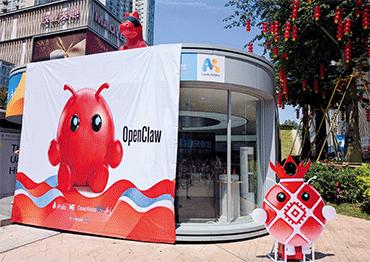
An offline OpenClaw experience exhibition jointly held by Shenzhen’s Shenyuan AI, Hong Kong’s MetaEra and Singapore-based iPollo opens at the Huaqianbei Global AI Application Scenario Center, Shenzhen, Guangdong Province, March 13, 2026 (Photo by VCG)

Potential Risks
Despite the symbolic role of AI agents like OpenClaw, which, according to Lee Kai-fu, CEO and founder of 01.AI, a Beijing-based AI company, is comparable to the creation of Linux, a free and open-source operating system developed in 1991, their applications, especially for OPCs, remain questionable. 

Ming Chao, co-founder of a five-person tech startup in Shanghai, told NewsChina that the biggest issue when deploying AI smart agents in the workplace is the instability of output at scale, especially in areas such as sales and traffic conversion. 

"There is a significant gap between an AI agent's applicability and its actual stable performance, which will consequently determine a startup's lifeline," he said. 

Ming said that due to inherent distractions and hallucinations, AI agents may produce frequent errors during the mass generation of in-depth marketing content. 

"In a complicated program, every erroneous step may finally lead to a big mistake that dissatisfies customers and drives up after-service cost," Ming said. 

Besides, the competition for AI startups will continue to be fierce, as the tech wave may not form the expected stable market. 

US-based Gartner, the world's leading consultancy focusing on technology, business, and IT-related decision-making, predicts 40 percent of agentic AI projects - which are proactive in making decisions - will be canceled by the end of 2027 due to escalating costs, unclear business value and inadequate risk control. 

Meanwhile, according to Dang.ai's AI Graveyard, a database tracking AI life-cycles, about 1,582 out of 5,492 AI tools on its website have been shut down, acquired or closed by April 2. 

Xie Manrui, an employee at a startup, told NewsChina that their biggest concern is the rapid upgrading of AI tools. For example, if a new AI agent replaces OpenClaw, their current products can be knocked out quickly as the ecosystem changes. 

In addition, without strict tests and compliance checks, some OPC products can result in data leaks and illegal information collection, Wang Xiaofan told NewsChina after surveying OPCs in the Yangtze River Delta region. This is because the rapid development of the industry has created a significant lag in regulations and monitoring. 

To tackle security issues, local governments have implemented several measures. In Longgang, authorities integrated OpenClaw with the domestically produced AI Network Attached Storage, a device to safeguard the use of the AI agent. Suzhou has implemented security and compliance certifications for the use of OpenClaw, and Wuxi follows the principle of least privilege by restricting what data OpenClaw has permission to access. 

"Those measures essentially put AI agents' autonomous planning, operation execution and cross-system calls into a cage," a startup founder told NewsChina on condition of anonymity. 

"However, what is not yet decided is how huge the cage should be and how many permissions these AI agents should have."

Print