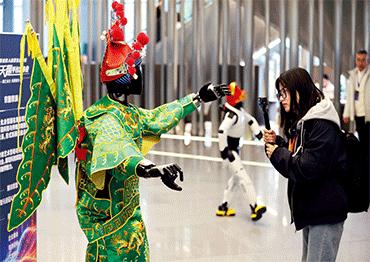
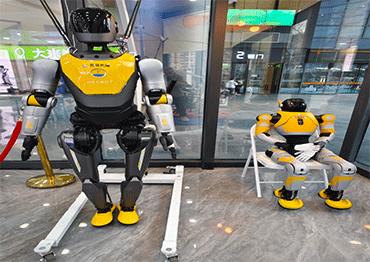
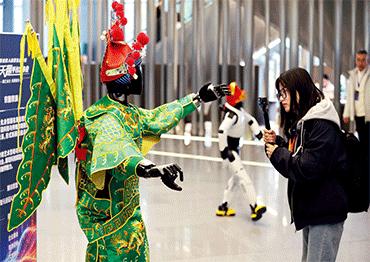
After watching the Gala in 2025, Lei began working with another company to program robots for more complex routines, like K-pop dances, the Charleston and kung fu movements.
Lei was among China's first wave of robot renters. He bought a G1 Edu in late 2024, and his unboxing video went viral.
This inspired Lei, already in the vehicle rental business, to expand into robots. Over time, he bought 10 models produced by different companies. But over the past year, daily rentals plunged from around 20,000 yuan (US$2,908) to less than 1,000 yuan (US$145). After deducting costs for wear and tear, shipping and travel, many late entrants barely break even, Lei said.
The price war intensified after robot rental platforms entered the fray. In December 2025, robotics firm AgiBot launched Botshare, focusing on its own robots, garnering over 200,000 registered users within three weeks. Along with Wanji Yizu, which aggregates several robot brands, the platforms rent robots at rates below the market average.��
"Robot companies are pushing humanoid robots into the consumer market through big platforms," Lei said, adding this aligns with their low-price strategy to win market share since mid-2025.
Humanoid robots started as luxury items. In 2021, UBTECH's Walker X cost 6 million yuan (US$872,292) on average. It sold only 10 units over two years.
But that quickly changed. By 2025, the company offered models under 300,000 yuan (US$43,615) to lower the entry threshold. Unitree's new bipedal R1 cost 39,900 yuan (US$5,801) the same year.
Booster Robotics followed months later with its Booster K1 at 29,900 yuan (US$4,378), while Noetix Robotics' Bumi sold in presale on JD.com for 9,998 yuan (US$1,464), the first to break the 10,000 yuan (US$1,453) barrier, comparable to electronics like high-end smartphones and gaming consoles.
"The main driver behind price reductions is supply chain advantage," said Zhao Tongyang, founder of EngineAI, a company known for its relentless cost efficiency. Shenzhen's dense supply network allows companies source highprecision components within a 100-kilometer radius.
A 2025 Morgan Stanley report found that China controls 63 percent of the humanoid robot supply chain, enabling Chinese companies to experiment with trial and error more freely and cheaply.
Overseas, manufactures need to design key components from scratch. Even Tesla relies on multiple Chinese suppliers to co-develop parts for its Optimus project, which aims to produce humanoid robots at scale to handle unsafe, tedious or mundane labor.
According to a Bain & Company report released in November 2025, falling component prices could slash production costs from US$40,000-50,000 today to US$10,000-20,000 by 2035, a 60 to 70 percent decrease.
 Old Version