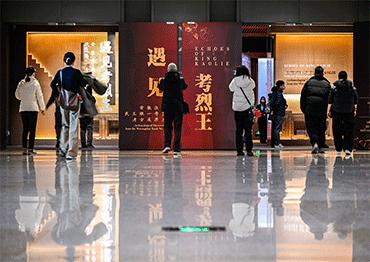
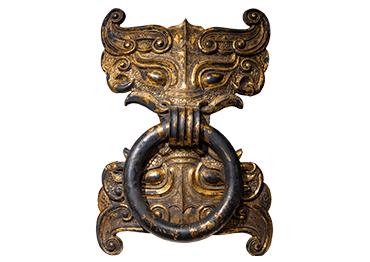
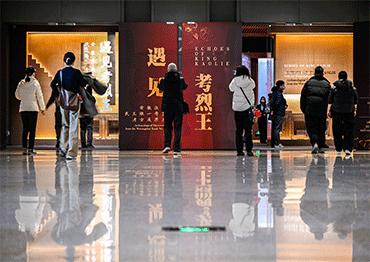
While King Kaolie may not be a household name, classic idioms born from the events during his time resonate through Chinese culture.
In 260 BCE, Qin State launched a massive invasion against Zhao State, besieging the Zhao army at Changping in North China's Shanxi Province. The experienced Zhao general, Lian Po, adopted a defensive strategy, refusing to engage the Qin forces in open battle in the hope of wearing them down.
The Qin army, frustrated by Lian Po's defenses, spread a rumor that the only general the Qin feared was Zhao Kuo. The king of Zhao believed the rumor and decided to replace Lian Po with Zhao Kuo, son of another famous Zhao general. He had studied military treatises from a young age but lacked practical experience.
Upon taking command, Zhao Kuo immediately abandoned the successful defensive strategy and ordered a full-scale offensive. The Qin forces feigned retreat, lured the Zhao army into a vulnerable position, and cut off their supply lines. Trapped for 46 days, the Zhao army was utterly destroyed, and about 450,000 Zhao soldiers were captured and buried alive.
Zhao Kuo was killed in the final battle, giving rise to the idiom Zhishang Tanbing, which means discussing military strategy on paper. It is used to criticize those who have vast book knowledge but no hands-on experience. Zhao Kuo became the ultimate symbol of the armchair strategist.
By 257 BCE, the Qin forces had besieged the Zhao capital, Handan, in North China's Hebei Province. Lord Pingyuan, a Zhao nobleman, was tasked with securing a military alliance with the powerful state of Chu to break the siege, but he was short one member for his diplomatic mission. A minor follower named Mao Sui stepped forward. He had been in Lord Pingyuan's service for three years but was completely unknown. Lord Pingyuan was skeptical but agreed to take him for his boldness, hence the idiom Mao Sui Zijian, meaning to volunteer one's services without being asked, with a strong positive connotation of seizing an opportunity to prove one's worth.
In the Chu court, despite Lord Pingyuan's urgent pleas, King Kaolie hesitated. Mao Sui, sword in hand, approached the throne and warned the king of the dangers the Chu would face if the Qin conquered Zhao State and compelled the Chu to swear an oath of alliance. The ceremony involved smearing blood on their lips, thus giving rise to the idiom Shaxue Weimeng, literally to smear blood on one's mouth and swear an oath of alliance.
After that, the Chu troops marched to the Zhao's aid. At the same time, Lord Pingyuan sent urgent messages to his brother-in-law, Lord Xinling of the neighboring state of Wei, pleading for the Wei to attack the Qin and save the Zhao. Lord Xinling repeatedly urged the Wei king, but the king refused, fearing the Qin's revenge.
In a desperate endeavor, Lord Xinling persuaded the Wei king's favorite concubine to steal the king's tiger tally. In ancient China, a tiger tally was a bronze token split into two and used as the ultimate military authority. The king kept one half, and the commanding general kept the other. An order was only valid when the two halves matched.
In this way, Lord Xinling commanded the Wei troops against the king's order to join the rescue. Today, the idiom Qiefu Jiuzhao, literally "stealing the tally to save Zhao," is used to describe a situation where someone takes unconventional or even unauthorized measures to achieve a greater good.
The combined forces of the Chu, Wei and Zhao finally lifted the Qin's siege, etching these idioms into history, with King Kaolie at the narrative center.
 Old Version