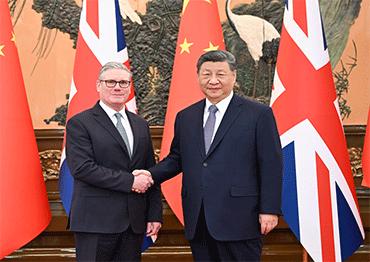
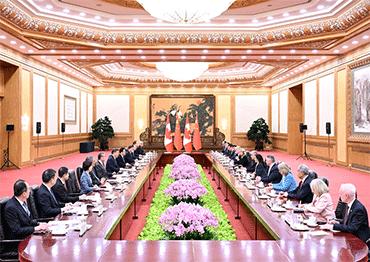
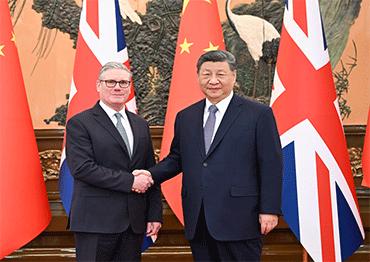
Although modest in scope, Starmer’s trip carried significant symbolic weight. Just days earlier, Canadian Prime Minister Mark Carney had returned from Beijing declaring a “new strategic partnership” with China and outlining what analysts have dubbed the “Carney doctrine” in a speech at the World Economic Forum Annual Meeting 2026 in Davos, Switzerland.
Calling on middle powers to unite and coordinate more closely and to diversify their economic and strategic partnerships to reduce overdependence on the US, Carney openly questioned the durability of the US-led international order. His remarks resonated widely among Western participants in Davos.
Although Starmer has not adopted language as explicit as Carney’s, the timing of his China visit raises a broader question: whether Washington’s European allies, including Canada and the UK, are beginning to reassess how they engage China in a changing global order.
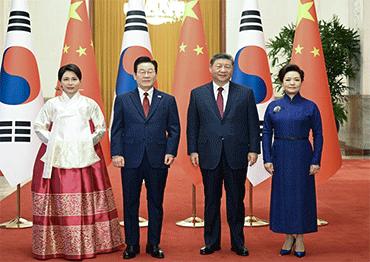
The trend appears to be underway. Starmer’s trip is the latest in a series of high-level visits by Western leaders to Beijing, many of which marked their first leader-level trips to China in nearly a decade. In January alone, Beijing hosted Irish Taoiseach Micheál Martin, the first Irish leader to visit China since 2012, Finnish Prime Minister Petteri Orpo, the first since 2017, as well as Carney, also making the first visit by Canada’s leader since 2017.
In December 2025, French President Emmanuel Macron paid his first official visit to China since April 2023, while Spain’s King Felipe VI traveled to Beijing in November, marking the first visit by a Spanish monarch in 18 years. German Chancellor Friedrich Merz is also reportedly preparing for his first trip to China in late February.
For many observers, Starmer’s visit is not an isolated diplomatic gesture but part of a broader Western re-evaluation, in which engagement with China is no longer driven primarily by ideological alignment but framed as a form of risk management in an increasingly unpredictable world.
“Starmer’s visit adds significant weight to the current wave of high-level interactions between China and European countries, providing an important window for observers to assess both the UK’s foreign policy and the development of China-Europe relations,” Feng Zhongping, director of the European Studies Institute at the Chinese Academy of Social Sciences, told NewsChina.
Feng noted that although the UK has left the EU, it continues to wield considerable influence in European affairs. Less than two weeks prior to Starmer’s visit to China, the UK participated in a joint statement by eight European countries reaffirming support for Greenland’s sovereignty, a move that prompted Trump to threaten 100 percent tariffs on those countries.
According to Chen Yang, a director at the China Institutes of Contemporary International Relations, as a permanent member of the UN Security Council, the UK’s decision to strengthen cooperation with China carries strong symbolic significance.
Chen noted that in recent years, the EU has described China as “a partner for cooperation, an economic competitor and a systemic rival,” a stance mirrored by the UK. He argued that by overemphasizing competition and framing the relationship in adversarial terms, this “triptych” framework has inflicted significant damage on European and British ties with China.
Chen added that the significance of Starmer’s visit lies in its role as a course correction, addressing the misapplication of the “triple positioning” approach. By reaffirming cooperation as the defining feature of the bilateral relationship, the visit has helped reinvigorate its positive dimensions.
This has long been China’s position on China-Europe relations. On January 28, China’s Foreign Minister Wang Yi said China and the EU are partners, not rivals, during a phone call with Emmanuel Bonne, diplomatic adviser to the French president.
Wang said China and the EU share similar positions on promoting multipolarity and can resolve trade disputes through dialogue.
Stressing that recent visits to China by several European leaders have advanced China-Europe relations, Wang said that China and the EU should “further enhance communication, promote mutual trust, and deepen cooperation,” according to the Xinhua News Agency.
According to Qu Hongbin, former chief China economist and co-head of Asia economic research at HSBC, there is significant untapped potential in China-Western cooperation.
“The experiences of China-Canada and China-UK relations show that cooperation between developed economies and China is not a zero-sum game,” he wrote in a recent post on the China Chief Economist Forum’s WeChat account.
“Resource-rich countries gain stable markets, manufacturing nations secure reliable supplies, and service-oriented economies capture increased consumption, while major consumer markets gain access to high-quality goods. Together, this creates value across the entire supply chain and boosts public welfare for all involved,” Qu added.
 Old Version