Yue Jianfu, former director of the heat supply department of Shijiazhuang’s urban management bureau, said the city started developing heat pump systems in 2015, when they were installed in a residential community in a high-tech industrial zone.
Yue told NewsChina that heat pumps were first used in areas where it was hard to extend traditional heating systems.
China’s energy transition began to speed up in 2014, according to Yue, as the central government promoted energy production and consumption reform. At that time, Shijiazhuang, like much of northern China was home to heavy industry and extensive coal mining and plagued by heavy air pollution. Rural areas still relied on coal for winter heating.
When government renewal programs started to demolish areas of old village housing which had been engulfed by urban expansion, construction of new apartment blocks provided an entry for heat pumps to be installed.
“In 2010, the area of Shijiazhuang covered by the centralized government heating system was 67.41 million square meters, but it shot up to 230 million square meters in 2025,” Yue said.
“In most northern cities, rapid urban expansion has brought about a sharp increase in demand for heat supply, and China’s carbon [reduction] targets have provided a good opportunity for the heat pump industry,” he added.
To control air pollution, Shijiazhuang demolished several big thermal power plants and central heating boilers in downtown areas, and developed a program that transfers surplus industrial heat from suburban plants to urban areas. In 2017 when the central government released its action plan on air pollution control, Shijiazhuang launched a clean heating program to replace coal use with clean energy. Similar programs were launched in other cities that suffered from heavy air pollution, like Beijing and Tianjin.
Clean heating includes electric and natural gas-powered heating. But as gas heating requires a pipe network and is affected by global price fluctuations, the “coal-to-natural gas” program did not run as smoothly as expected.
“Many suburban or remote and rural areas didn’t have a gas pipe network, given the huge cost of construction and maintenance. But every corner of China has electricity, so ‘coal-to-electricity’ is more suitable for those areas,” a retired engineer surnamed Gao, a former employee of a coal-fired power plant in Beijing, told NewsChina.
Media reported that in the winter of 2017, the “coal-to-gas” program was stymied by a rush to replace coal heating systems in homes before other systems were in place – and lack of natural gas. China’s self-sufficiency ratio of gas was 59 percent in 2023, according to a 2024 report by the National Energy Administration.
Experts warn that gas is not always the best solution for heating in some remote areas, and that it still emits air pollutants like nitrogen oxide, though at much lower levels than coal burning.
Wang Zhigao, urban and regional development executive director of the Energy Foundation (EF China), an independent organization focused on clean energy and emissions reduction, told NewsChina that a heat pump system is more flexible than a traditional heating system. They can either be installed in each household or homes can be part of centralized heating networks like in Shijiazhuang’s Zhao County.
According to engineer Gao, Beijing’s “coal-to-electricity” program started in 2003, mainly in suburban and rural areas. The program has since accomplished 80 percent of the required replacement.
“We installed our first [household] heat pump in 2015. Before that, we used coal... and we had to spend so much time transporting and cleaning up [storage areas],” Lü Chao, a resident in a village in the outskirts of Beijing, told NewsChina.
“The government is really promoting the ‘coal to electricity’ program by subsidizing this transition. Since 2015, 100 percent of the households in our village have shifted to heat pumps,” he said, adding that the government provided pumps to each household for free and gave villagers subsidies for electricity use.
“In my old home, which was about 70 square meters, we had to spend at least 4,000 yuan (US$574) just for heating each year based on the coal price 10 years ago. That was for about three tons of coal. Since we started using the heat pump, we’ve been paying less than 3,000 yuan (US$429) for electricity annually,” he said.
Lü and other villagers told NewsChina that their homes feel warmer now than when they burned coal, and the heat pumps are more stable and convenient.
Energy efficiency is expressed by the coefficient of performance (COP). For heat pumps, it is measured by dividing the heat output by the electrical energy input. The higher the COP, the more efficient it is.
“The COP of heat pumps is usually 2.5-4, and maybe higher than 4 when the surrounding environment is particularly suitable. It means each unit of electricity consumed has an output of four units of heat,” Zhao Hengyi, deputy director of the China Energy Conservation Association (CECA), told NewsChina.
“In North China, heat pumps may maintain the temperature at 18 C or above, and they can operate even in extremely cold [northern] areas like Harbin and Mohe where it’s often -30 C in winter, though the COP may be a bit lower,” Wang Zhigao said.
“Compared to air conditioners, heat pumps are designed to apply to a wider range of areas, especially in extremely cold areas where heat pumps are much more stable and efficient,” Gao said.
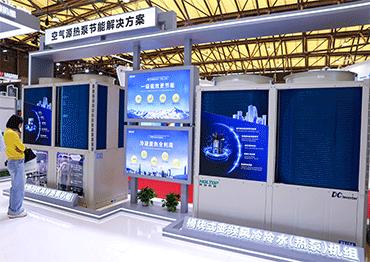
 Old Version