Through technology, social media and public outreach, Beijing’s Longquan Temple is trying to change the face of Chinese Buddhism by merging the age-old religion with cutting-edge trends
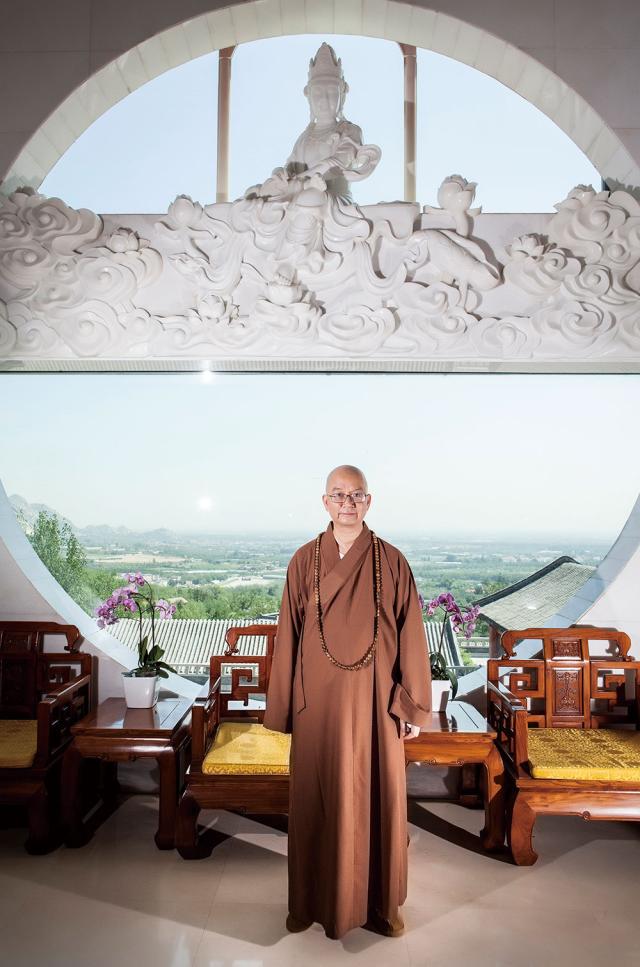
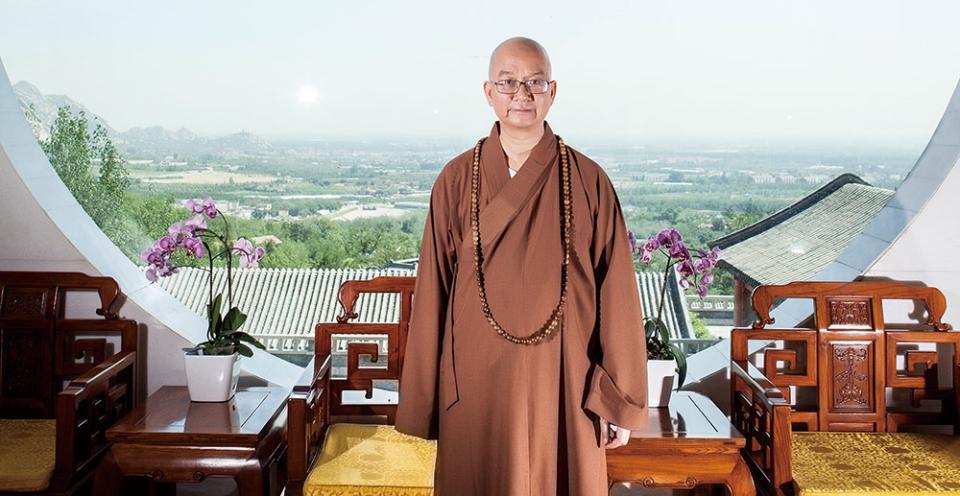
Venerable Master Xuecheng / Photo by Qinbin
Xian’er is chattier than the stereotypical monk. Sporting traditional saffron robes and a shaved head, he always responds if you ask him a question, exclaiming “Let me ask my master!” if he doesn’t know the correct answer. When asked what he eats, however, his rejoinder might strike some as strange: “I don’t eat.” This is because Xian’er is a robot. He doesn’t have to eat.
The two-foot-tall monk is based on a cartoon character developed by northwest Beijing’s Longquan Temple, an institution that dates back to the Liao Dynasty (907-1125). When the temple launched an account on Sina Weibo, China’s Twitter equivalent, it designed the cute Xian’er as well as the character of an erudite master monk so that the temple could explain complicated Buddhist concepts on its Weibo feed through simple illustrations.
When the robotic version of Xian’er first met the public last September, his image immediately went viral. This was not the first time that the once small, run-down Longquan Temple had entered public consciousness. Longquan actually has a great number of followers both online and offline, at home and abroad.
This is because of a key principle that distinguishes Longquan from other temples, something Xian’er exemplifies: the blending of ancient wisdom with 21st-century technology. The temple has a reputation for being a “high-tech” institution that is home to a group of academically gifted monks and a strong scientific research team. Inspired by the temple’s leader, Venerable Master Xuecheng, this young generation of tech-savvy monks, rather than isolating themselves deep in the capital’s remote northwest, utilize cutting-edge technology to not only improve the temple, but also promote Buddhism to the public through innovative methods. In this way, they are attempting to change the future of Chinese Buddhism.
Geeky Monks
Longquan Temple stands at the foot of Phoenix Mountain, more than an hour’s drive from the city center, its red pagoda bright against the backdrop of the capital’s gray, rocky Western Hills. Although it’s difficult to imagine, this famous temple was practically deserted as recently as 11 years ago, home to just five monks and an inadequate water supply problem. Its road to rejuvenation started in 2005, when Ven. Master Xuecheng took charge of it and initiated a series of transformations. As he told NewsChina, the key to Longquan’s rebirth lay in the talent of its followers. There is a reason why Longquan’s residents have earned the nickname “geeky monks.”
Master Xianxin is a perfect example. At the 2011 Mobile Developer Conference China, amongst a sea of computer programmers and manufacturers, the monk, clad in saffron robes, stood out like a blotch of technicolor on a black-and-white TV. Conference attendees were amazed by the fact that a monk could code. After the story broke online, netizens were astonished to find out that Longquan even has its own IT department dedicated to improving the temple through technology.
In fact, the digital world has penetrated every corner of Longquan. Its monks use a self-devised computer program to compare and contrast classic Buddhist texts. Lay Buddhists can apply for temple library cards that allow them to borrow books electronically. Access to some of the most important areas of the temple is restricted to those whose fingerprints are logged within a fingerprint recognition system.
And the IT team is not the only departmental addition that is unique to Longquan. The temple has its own animation center, where the character Xian’er was originally developed. Longquan’s animators initially used paints and calligraphy brushes to illustrate Xian’er in a single frame, later evolving to four-frame comic strips, according to Master Xianshu, one of Xian’er’s creators. Eventually, the animation center successively produced Xian’er stories in 2-D animation, 3-D animation, stop-motion animation, and even animation made with dough figurines, a traditional Chinese art form in which figures are crafted from glutinous rice flour dough. Xian’er’s robotic form is his most recent incarnation. Master Xianshu said the world can expect the introduction of a robotic Xian’er 2.0 soon as well; the second-generation version will be more intelligent and have more functions.
The successful “modernization” of Longquan Temple has been attributed mainly to the management of Ven. Master Xuecheng, whose knowledge of technology sets him apart from other Chinese Buddhist leaders. At age 50, he is the youngest-ever president of the Buddhist Association of China. His relative youth showed through in his April 2015 inaugural speech, in which he stressed the importance of the relationship between Buddhism and technology while discussing the religious community’s future development.
Ven. Master Xuecheng stays on top of technological trends, much like your average millennial. He talks comfortably about the Internet of Things, Twitter and new media. In his view, the Internet opens up limitless prospects for the promotion of Buddhism. He first began using the web actively in 2006 as a blogger, just as blogging began to gain popularity in China. In 2008, under his instruction, the temple launched its official website. He opened his own Sina Weibo account the following year and currently has more than 40 million followers. Every day, after his morning prayer, he goes online and spends an hour interacting with netizens, answering their questions and giving religious counsel. His Weibo posts have been translated into 12 languages by the temple’s translation center, making his words accessible to three-quarters of the world’s population.
From the perspective of Ven. Master Xuecheng, Buddhism is an ancient form of wisdom, but Buddhists are modern. “If Buddhists reject the Internet, then they have no power,” he stressed.
Ivy League Temple
Longquan’s followers not only stand out for their technological prowess, but also for their impressive academic backgrounds. The temple has attracted a number of monks with degrees from universities belonging to China’s equivalent of the Ivy League. Many of these monks earned doctorates or even held positions as university faculty members. Netizens have crowned Longquan the “Straight-A Temple” and “Branch Campus of Peking University and Tsinghua University,” referring to what are arguably China’s top two post-secondary institutions.
Longquan’s ranks include Master Xianqi, the temple’s cultural department head, who holds a doctorate in nuclear and thermal energy from Tsinghua University; Master Chanxing, Longquan’s monastic manager, who has a PhD in hydromechanics from Tsinghua University; Master Xianqing, who has a master’s in philosophy from Peking University; and Master Xianzhao, who used to be a professor at Beihang University.
Among the many academic stars-turned-monks, Master Xianyu is the most famous. Before he converted to Buddhism, Liu Zhiyu – Master Xianyu’s secular name – won the 47th International Mathematical Olympiad, a global high school competition, and graduated from Peking University’s School of Mathematical Sciences. Liu shot to fame in 2010 when he gave up a full scholarship to MIT and instead chose to devote himself to Buddhism at Longquan Temple. Liu’s decision ignited a national conversation about whether or not a top university student who chooses a monk’s life was wasting his talent.
One of the reasons Longquan can attract such brilliant youth is its location. The temple’s home in Haidian District positions it relatively near Beijing’s educational center, an area that is teeming with top-tier universities and research institutions. One Longquan monk who is also a Peking University alumnus told NewsChina that the temple’s convenient location allowed him and many of his like-minded classmates to visit frequently. They would come to Longquan for Zen lessons or volunteer work. “If the temple were far from my university, I would not have been able to come here and I would probably never have converted to Buddhism,” he said.
Many argue that it is a waste for young people with such remarkable educational backgrounds to become monks. Ven. Master Xuecheng could not disagree more with this mindset. “As a matter of fact, the tranquility of the temple can help these smart young people avoid a restless heart and turbulent lifestyle so as to achieve inner peace,” he told NewsChina. “This will help young people explore their talents and uplift their spirits so that they can achieve results that would be hard to attain in other fields.”
Becoming a Longquan monk is not an easy task; just because a potential candidate has graduated from one of China’s top universities doesn’t guarantee that he has what it takes to join the temple. Master Xianfa told NewsChina that Longquan Temple employs a structured training system to assess whether someone is qualified to become a monk. It does not matter what secular accomplishments a postulant has achieved during his previous life; once he decides to convert to Buddhism, he will be judged on a completely different set of criteria.
To become an official Longquan monk, a postulant must work through five ranks: volunteer, kappiya-to-be, kappiya, lay Buddhist and, finally, Buddhist monk.
Achieving monkhood does not mean a time of rest and relaxation is imminent. Young, smart and tech-savvy as they are, monks at Longquan are supposed to live an ascetic life. They rise at exactly 3:55 every morning and go to bed at 9:30 in the evening. Before each of their three meals, all of the monks are required to chant sutras. Apart from this, mealtimes demand silence; no one can talk, chew loudly or even tap chopsticks audibly against a bowl.
If monks want to use a computer or go online, they need to submit an application. Except for a few master monks in charge of management, most monks are not allowed to own cellphones. None of the monks are paid an allowance or salary, but their room and board is provided by the temple.
The strictness of Longquan’s policies does not deter massive numbers of followers and postulants, however. The temple has attracted hordes of full-time and part-time volunteers. Each department has dozens of full-time volunteers, who sometimes live at the temple for years. Part-time volunteers far outnumber their full-time brethren, though; for example, the translation center alone has over 500 part-time volunteers.
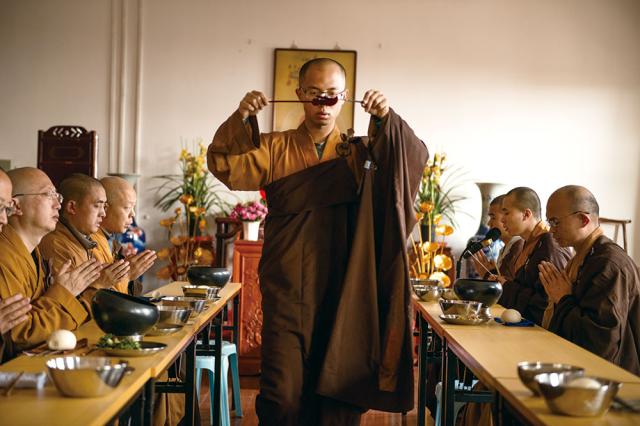
Monks at Longquan Temple have a strict dining ritual. After the pre-dining chant, a monk holds a wood vessel and walks slowly between the two dining tables as the ceremony’s last step. Only when the monk leaves the room can the others begin to eat / Photo by Dong Jiexu
There is a tea room in Longquan Temple’s animation center, in which people can watch movies and surf the Internet / Photo by Dong Jiexu
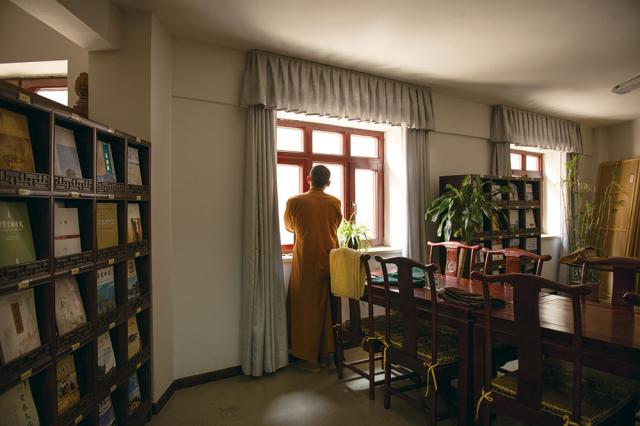
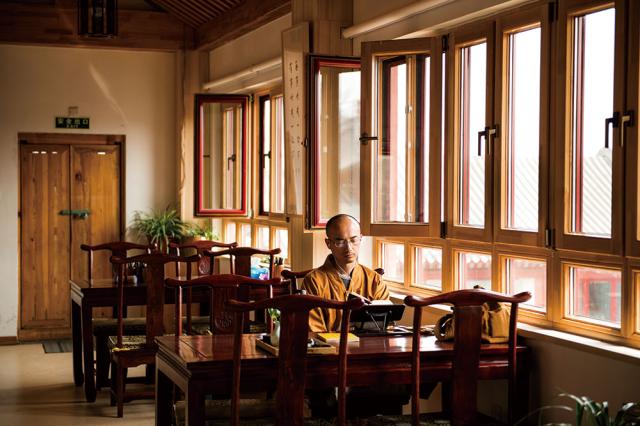
Longquan Temple’s quiet library offers a peaceful environment in which monks can study / Photo by Dong Jiexu
Opening Up
Ven. Master Xuecheng’s goal is to transform Longquan and Buddhism as a whole by having the temple interact with the public more directly.
For example, Longquan reaches out to the public by providing free Zen classes. The temple also gives Longquan devotees and visitors a complimentary vegetarian lunch. The food, along with fruit and coffee, is prepared and distributed by volunteers. Master Xianwei told NewsChina that more than a thousand people dine at the temple on its busiest days, like when the temple holds a ceremony.
While Longquan offers free food for everyone and free lodging for volunteers, it remains one of very few temples in China that do not charge an entrance fee or impose a minimum donation. (This is not to say that the temple does not accept donations – donations from followers make up Longquan’s main pillar of support. For example, donations from 56 overseas Chinese paid for the temple’s international branch, Longquan Great Compassion Monastery, which opened in Utrecht, the Netherlands, last December.)
Its constant interaction with the secular world helps Longquan attract more volunteers. A volunteer who works in the temple’s kitchen told our reporter that she loves this temple dearly; she loves the lush greenery, the fresh air and the carefree, friendly environment. “The temple calms you down,” she said. “Inside, you never feel restless or beaten down.”
A lay Buddhist told NewsChina that Ven. Master Xuecheng’s attempts to reform Longquan are “very meaningful.” “It represents a very positive direction for Chinese Buddhism: Humanistic Buddhism,” the temple-goer said.
The concept of Humanistic Buddhism arose during the late Qing Dynasty (1644-1912) and in the early post-imperial period. It advocates that the aim of Buddhism is not to instruct followers to retreat from the secular world and live like hermits, but to use Buddhist ideas to improve society and make the world a better place. This school of thought encourages Buddhists to play an active role in secular society.
Practicing Humanistic Buddhism and actively getting involved in the secular world does not mean becoming secularized, however. “The function of Buddhism is to purify and nurture the secular world instead of being secularized, to cultivate the commercial world instead of being commercialized,” Ven. Master Xuecheng, who is also a member of the National Committee of the Chinese People’s Political Consultative Conference (CPPCC), told the media during the CPPCC’s annual meetings in March.
Ven. Master Xuecheng has spent years contemplating how to manage a temple in a way that enables it to follow traditional Buddhist disciplines while at the same time keep pace with modern times. His ideas were realized through Longquan. Technology and religion, modernity and tradition, involvement with the secular world and pure spirituality – he is constantly striving to keep all of these dynamic elements in balance.
Ven. Master Xuecheng hopes that more temples will step out from self-isolation and practice Humanistic Buddhism more actively. “A temple needn’t be lofty; it is divine as long as it has faith,” he said. “A temple needn’t be famous; it is prosperous as long as it has devout followers. A temple might be small, but its followers need to have an open mind, a broad vision and a strong wish to interact with the larger world.”
 Old Version