Old Version
Politics

Application Overreach

Faced with a multitude of administrative apps set up by governments at all levels, now consolidation and deletion is needed to streamline processes

By Qiu Qiyuan , Ni Fenfen , Fang Siwen Updated Apr.1

To complete his registration of a second property and transfer his utility accounts, Liu, who lives in Southwest China’s Sichuan Province, logged onto an app launched by the provincial government for one-stop administrative services. 

After going through a number of interfaces on his phone, he was told he had to complete the procedures on another platform, called the “provincial government service portal.”  

“If the app can’t access provincial administrative services, not even with a redirection to the new portal, why should the government roll it out in the first place?” Liu told the People’s Daily in August 2025.  

Liu is far from the only person confused about government procedures. Wang Xiaoxiao, a community official in Central China, has to use an app for work, providing assistance to needy children in her area, but found that in-app restrictions impeded her job.  

“My area only has five children that meet the criteria for assistance, but the registration app used by higher departments to evaluate and give instructions requires at least 10 children,” she told NewsChina. To complete her task, Wang added several migrant children to the list so she could achieve her annual key performance indicator (KPI), but the additional visits meant unnecessary extra workload.  

Over the past few years, governments at all levels have gone to great lengths to devise apps to streamline administration and improve services, but the programs have created many inconveniences and perplexities among users.  

According to the National Informatization Development Report (2024) issued by the Cyberspace Administration of China on July 30, 2025, 46.2 percent of respondents aged between 17 and 80 from 31 provincial regions complained that most government apps they have to use cover similar functions.  

The central government issued new rules aiming to reduce red tape and workload burdens in August 2025. As well as reducing the number and length of meetings, speeches and official documents, and the number of inspections, the guidelines say local governments should not launch new apps without approval, and each Party or government agency can only maintain one primary app, the Xinhua News Agency reported. Use of apps cannot be mandatory, nor can they be used to track attendance metrics or evaluate performance. Boosting the app by artificial likes, votes and shares is banned. The rules aim to free up grassroots officials from repetitive and tedious tasks to allow them to undertake more work in communities. 

Experts said merging and deleting apps with identical functions is the only way to improve efficiency.  

“At the very least, people will not be confused about which to choose when they see 10 apps they have downloaded to access specific government services,” Fu Zitang, a professor at the Southwest University of Political Science and Law, told the People’s Daily. 

Sweeping Shutdown 
Wang also handles applications for government subsidies for public rental housing. Her work requires her to be familiar not only with the app developed by the city government, but two additional apps from the provincial government with the same functions.  

“We’ve all learned how to use the city government’s app, but not many of us know how to use the provincial ones,” she told NewsChina. But they need to keep the provincial apps in case of inspections.  

There have been changes. More than half the government apps installed in Wang’s phone have been amalgamated or shut down since the beginning of 2025. She only has about five work-related apps on her phone.  

So far, millions of redundant government apps and zombie work chat groups have been cleared out and 50 percent of supervisory and evaluation items have been deleted, the China Organization and Personnel Newspaper reported on November 5, 2025.  

By July 2025, authorities in Huzhou, Zhejiang Province had inspected 760 apps operated by city and district authorities. Four months later, 200 apps were deleted or combined, the Huzhou Daily reported on November 3, 2025.  

“We targeted three categories of apps – ones with almost zero active users over the past three months, ones that weren’t used much, and apps that contained fragmented and disorganized programs,” Pan Mingjie, director of the Development and Planning Department of the Huzhou Data Bureau, told the Huzhou Daily.  

In Guangxi Zhuang Autonomous Region, 118 apps from more than 40 government agencies were integrated into a single platform to provide public services and government administration. 

Compared to previous apps which were mostly used by government agencies, the new platform is more comprehensive, providing services for governments, business entities, local residents and visitors, said Wang Haining, manager of Guangxi Zhiguitong Science and Technology, the company that provides technical support for the new platform.  

Launched on March 30, 2022, the app has attracted 46.32 million verified users, over 1.7 billion visits and more than 160 enterprise registrations, according to the company website.  

In Jiangsu Province, four provincial departments, including the Data Bureau and the Development and Reform Commission, issued a circular on June 27, 2025 to address app redundancies. One of the measures is that administrations below county-level can no longer develop apps.  

An executive from a science and technology company in the province, who spoke to NewsChina on condition of anonymity, said that in response to the policy, a majority of government apps had been closed or merged. “We no longer partner with governments to develop administrative apps,” the executive said.  

In 2024, Guangdong Province carried out similar policies as well. All government departments in the province were asked to check their apps to see if they are redundant or inefficiently operated. All identical programs had to be amalgamated and all inefficient platforms deleted. 
 
An anonymous executive from a Guangdong-based software development company told NewsChina that most government apps used by city-level departments today are developed and operated by the provincial government. “Administrations below cities won’t launch apps anymore,” he said. 

‘Digital Mirage’ 
The use of government apps took off around 2018 and 2019, though in some well-developed coastal cities the number surged even earlier, Li Ling, who works at a software development company, told NewsChina.  

Zhang Jianhua, a community official in a city in Southwest China, said the trend for apps started in 2017.  

“All departments including education, civil affairs, politics and law, as well as land and resources wanted an independent vertical management system and none wanted to lag behind. This was when tech companies started this [app] business,” Zhang told NewsChina.  

According to the Statistical Report on China’s Internet Development issued by the China Internet Network Information Center in March 2023, there were 95,000 government-issued apps in 2022, up 20 percent year-on-year.  

Zhang said there are two reasons behind this boom. On one hand, digital platforms streamlined many administrative tasks that previously had to be done in person – signing official documents which could now be done online, for example.  

On the other hand, people mistakenly believed that if one agency had their own app, all agencies needed them or they would be left behind.  

If duplicate apps are developed by both city and district governments, the district one, regardless of how much investment was put into it, is more likely to be closed simply by an order from higher authorities, Li told NewsChina.  

According to Li, many governments had no idea that an app needs updates, debugging and upgrading in response to user feedback.  

In addition, some community-level governments were assessed by how well they did in keeping the apps active. Staff at authorities whose apps rank lowest should receive public reprimands and submit self-criticism letters, Zhang told NewsChina.  

However, to ensure the apps appeared high in the rankings, some governments provided fabricated data. According to Zhang, he found that one app that was highly ranked was in fact kept active by fake registrations. Dozens of accounts were linked to around 30 handsets owned by one official in charge of mobile interaction.  

Online stores also sell services to increase registrations and engagement on government apps. An employee of one such store told NewsChina on condition of anonymity that they have been doing this business for nine years and worked with several well-known government apps.  

“We only use real people to increase engagement. We charge around 1 yuan (US$0.14) per person for fake name registrations. But for some regions that set conditions on registering (such as location) the charges could be higher, like 17 yuan (US$2.43) per person,” the staff member said, adding that the business has showed no signs of decline in the last couple of years.  

These identical government apps with falsified interaction metrics will only increase governance costs, Wei Chenglin, an associate professor at the Political Science and International Relations at Shanghai-based Tongji University told NewsChina. “Without genuine data support, these practices amount to nothing more than a digital mirage,” Wei said. 

Digitally Stuck 
Many government apps are designed to make it easier for higher authorities to supervise subordinate departments, but often they are just a waste of time, sociologist Lü Dewen of the Research Center on Rural Governance in China at Wuhan University in Hubei Province told NewsChina.  

“Many of the assessments aren’t practical [in their design], so these apps can’t really increase supervisory efficiency,” he said.  

Wang Xiaoxiao said her job evaluation incorporates two indicators: changes in residential household registrations and dispute resolution cases. Because the community she works in has been there for a long time and houses many seniors, the population is relatively stable and does not experience many disputes. If she had not fabricated some statistics and cases, she would have failed her job assessment.  

According to Wu Chunlai, an associate professor from the College of Humanities and Social Development, Northwest Agriculture and Forestry University in Shaanxi Province, many tasks undertaken by community officials cannot be reduced to being evaluated on an app, and attempting to do so will bring unnecessary pressure.  

Already in March 2019, the General Office of the Communist Party of China Central Committee vowed to alleviate the burden of community governance by issuing a notification titled Notice on Reducing Burdens at Grassroots Level to Solve Prominent Problems of Formalism. According to the circular, the key element to evaluate a community-level official’s job should be people’s real reactions to the efforts they make to solve problems, rather than screenshots uploaded to WeChat work chat groups or government apps. 

Data Sharing 
However, Wei cautioned the closure of government apps should not take a one-size-fits-all approach, otherwise red tape can emerge in new forms.  

For instance, a county government in the west of China closed all apps and online work chat groups, only to find their work efficiency plummeted, he told NewsChina. 
 
According to Wu Chunlai, closing all apps was never the ultimate goal. The more significant purpose is to build an orderly systematic and institutional digital governance. To this end, all government data should be well organized and interconnected.  

The data should be both complete and accurate, Wei Chenglin told NewsChina.  

However, based on a series of interviews with a number of community-level officials and experts, government data sharing has remained a problem, leading many to question why they are forced to collect data in the first place.  

“Few higher-level departments reveal their feedback after they collect, check and update data provided by community-level administrations. This is not only detrimental to grassroots governance but also results in an unequal distribution of powers and responsibilities between them,” Wei said. Community agencies are tasked with too many duties, but their efforts are ignored, as they receive little feedback or recognition from their superiors.  

In 2020, the Information Center of the State Administration for Market Regulation published an article which said that some officials believed government data was their departments’ assets and resources. They felt that possessing such data was a particular kind of power and the integration or sharing of the data would result in a loss of power.  

On August 1, 2025, the State Council adopted the country’s first Regulations on Government Data Sharing. The new regulations highlight that rational and legitimate sharing of government data should not be hindered by unauthorized interventions. It also requires that lower government levels must have access to any data they need to fulfill their duties after it is collected by higher levels.  

“Based on our investigation and research in the rural areas, we noticed that the systematic collection of information by higher governments can help community officials distinguish whether specific opinions and appeals from the public are cyclical or usual. This information has helped officials with prioritizing tasks and solving problems,” Wei said.  

“However, to facilitate community administration, there must be a regular and systematic practice of data sharing among governments,” he said.

People use self-service machines at an administrative service center, Hefei, Anhui Province, November 8, 2022 (Photo by VCG)

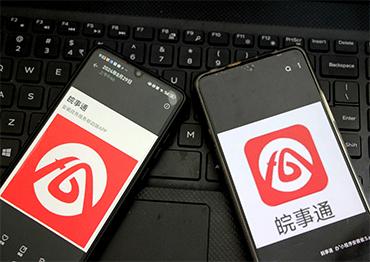
An administrative service app launched by Anhui provincial government, August 29, 2024 (Photo by VCG)

Print