Old Version
Cover Story

Culture Shift

A foreign degree is no longer a unique advantage for returned graduates, as employers place greater value on cross-cultural competence

By Xie Ying , Lü Yaxuan Updated Apr.1

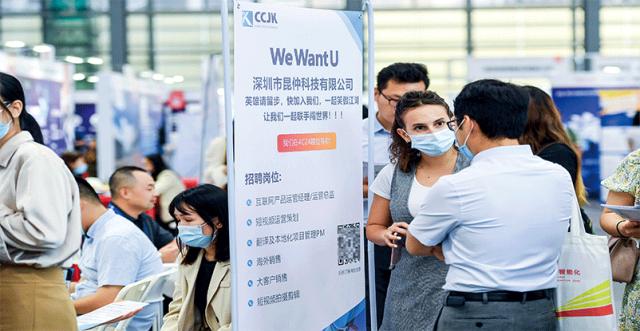
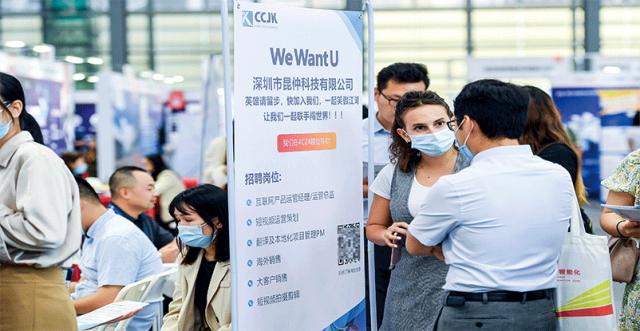
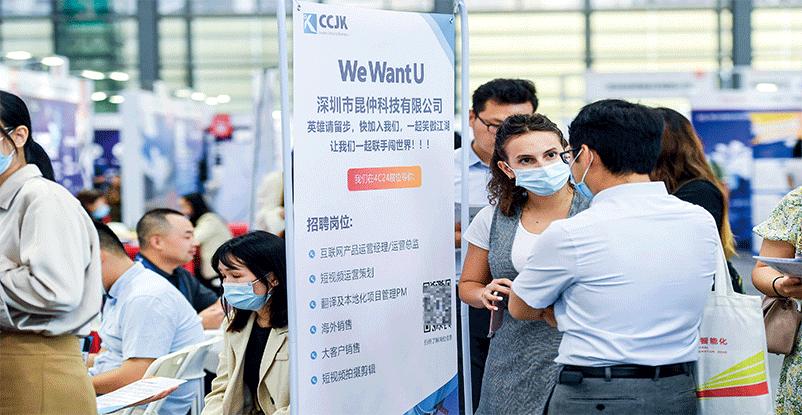
A job hunter speaks with an employer at a job fair for returning overseas graduates launched by the Conference on International Exchange of Professionals held in Shenzhen, Guangdong Province, April 24, 2021 (Photo by Xinhua)

Standing in Beijing’s first snowfall of winter on December 12, 2025, Zhou Junjun felt a deep chill. She had just learned she did not pass her final interview for a teaching position at an online English training institution. 

Holding a master’s degree in linguistics from the University of Cambridge, Zhou flew from Xi’an, Shaanxi Province, to China’s capital for the interview. After three days of intensive training, she was asked to deliver a trial lecture.  

This was supposed to be her fallback option. Zhou’s preferred choice was a job at a major internet company, but she was rejected due to a lack of industry experience.  

Like Zhou, many returned overseas graduates are finding it increasingly difficult to secure jobs that meet their expectations. Data from China’s Ministry of Education show that 495,000 overseas students returned to China in 2024 for work, entrepreneurship or other career development, up 19.1 percent from 2023.  

The trend lines up with the 2025 Investigative Report on Employment of Returned Chinese Overseas Graduates by LinkedIn, a global platform for career and employment exchange, which found that 54 percent of Chinese overseas students returned to China for work, up 18 percent from 2024. The surge has intensified competition in the job market and eroded the premium once associated with degrees from overseas. 

Short Supply 
Shandou, a master’s student in politics at the Chinese University of Hong Kong who is set to graduate in July, began job hunting last September, the same year he enrolled. In a month, he had submitted more than 80 resumes to internet companies, manufacturers and media outlets, and participated in over 20 written exams and interviews. He did not get a single offer.  

“I’ve spent a huge amount of time in job hunting and traveling back and forth between the mainland and Hong Kong for interviews,” he said. He had just completed a group interview with a media outlet in Guangzhou, Guangdong Province, followed immediately by a written exam for another newspaper.  

“The pressure of job hunting from the moment we enter university hangs over all mainland students in my class,” he said. “We’re constantly polishing our resumes, even during lectures.” 

Yang Peng, director of the Shenzhen Overseas Chinese Returnees Association and CEO of JOBS, a recruitment platform for returned graduates, told NewsChina that since 2023, the job fairs his company organizes each spring and autumn have grown increasingly crowded. “In the past, fairs in Shanghai and Beijing attracted fewer than 1,000 returned graduates.  

In the past two years, that number has doubled,” Yang said. “With competition so fierce, some graduates even bring their parents to help distribute resumes.”  

Yang attributes the intensified competition to shrinking labor markets in traditional destination countries for overseas students, such as the US and Europe, amid a global economic slowdown. This has pushed more graduates to return to China for work. A 2024 report by Zhaopin, a leading Chinese recruitment platform, showed that graduates from US universities accounted for 10 percent of all returned graduates.  

“Due to the shrinking market and geopolitical factors, many Chinese students in the US who wanted to stay there and work for an American tech firm or scientific institute have to return to China for a job,” Yang said.  

Huang Yun, a human resources manager at a leading foreign-invested public relations firm, described the influx of returned graduates as a “flood.” “When I joined the company nine years ago, returned graduates made up less than 30 percent of applicants. Now, the figure has risen to more than 50 percent,” she said.  

State-owned enterprises (SOEs), once a less popular option for returned graduates, are also seeing the shift. Wang Ting, a human resources manager at a State-owned vehicle manufacturer, told NewsChina that five years ago it was difficult to attract returned graduates. In the past two years, however, this share of applicants has risen sharply, from 10 percent to more than 30 percent.  

However, many domestic industries that once hired large numbers of returned graduates are scaling back recruitment. Wang’s company halved its hiring plans in 2025, while Huang Yun said her firm laid off one-third of its staff in Beijing and Shanghai.  

Cutthroat competition has also driven down salary expectations. The 2025 LinkedIn report on job hunting among returned Chinese graduates found that while about 17 percent of top-tier talent maintained expectations of around 25,000 yuan (US$3,571) per month, a growing number lowered their expectations to between 8,000 and 12,000 yuan (US$1,143-1,714). 

Talent Mismatch 
Yang argues that many quality positions are available in the job market.  

“An enterprise won’t pay to post recruitment ads on job platforms unless it genuinely needs new employees,” he said. “The core problem is that returned overseas graduates often do not match these positions. In other words, supply and demand are misaligned.”  

According to Yang, the main reason for this mismatch is that many job seekers have an overly narrow view of their career paths.  

“For example, at one of our job fairs, a world-leading optical fiber manufacturer in Jiangsu Province, with annual revenue in the hundreds of billions of yuan, received very few resumes,” Yang said. “That changed only after the company’s top executive gave a presentation introducing the firm. The company is expanding overseas and has many positions suitable for returned graduates, but many candidates simply ignore companies they haven’t heard of.”  

Ji Beibei, who works in overseas study training and consulting in Anhui Province, agreed. She said many of her students hope to join large, well-known private companies, which they perceive as having a freer and more flexible environment than government agencies or SOEs. At the same time, many STEM graduates believe they can better apply their expertise at prominent private firms.  

But some just lack clear career goals and simply follow prevailing trends. Zhou Junjun told NewsChina that she applied to numerous internet companies mainly because people around her said they offered high salaries and generous benefits. During her undergraduate years, she focused on academic studies and preparing for postgraduate exams, leaving little time for internships or career planning.  

The 2025 LinkedIn report found that nearly 50 percent of surveyed Chinese overseas students preferred jobs in the high-tech or internet sectors.  

This preference does not always align with employers’ expectations. “We favor candidates who have a clear sense of their career direction, which is often reflected in their internship experience,” Huang said. “Unfortunately, we see very few such applicants. Many simply submit resumes to every possible position without knowing which industry they actually want to enter.” 

Shandou reached the final interview round at a leading mobile phone manufacturer, but was ultimately rejected. The employer told him he lacked internship experience involving direct consumer engagement, which was a must for the position.  

“I hoped earning a master’s degree in Hong Kong would strengthen my profile,” he said. “But it turned out that employers value internship experience more than academic credentials.”  

Yang Peng pointed out that many returned graduates hold biases against certain professions. Sales, for example, is often overlooked, even by commerce majors, as it does not carry high social status in China.  

“Many parents don’t support their children going into sales,” Yang said. “But according to JOBS data, sales positions are among the most urgently needed by companies.”  

Zhou Junjun has also struggled with professional bias. One of her undergraduate instructors told her it would be a waste of her Cambridge degree to work as a teacher at a private training institution.  

“In many people’s eyes, studying abroad should lead to higher positions and better resources,” she said. “If we end up in what are seen as ordinary jobs, it’s considered a failure or a waste.” 

That perception, however, has been challenged by reality. Zhou’s master’s degree from Cambridge did not secure her a position at the training institution, as overseas credentials no longer play a decisive role in determining whether a candidate meets the specific requirements of a job.  

“Compared with academic degrees, we place greater emphasis on skill fit and internship experience,” Huang said. “What matters most is whether a candidate can contribute effectively and adapt quickly.” 
New Advantages 
Yang Peng noted that employment pressure is not evenly distributed among overseas graduates. Compared with those majoring in the liberal arts, science and engineering graduates generally have more employment opportunities in China.  

In April 2025, internet giant Tencent announced its largest-ever hiring plan, opening 28,000 internship positions over three years, with 60 percent targeting technology talent. In addition, several leading manufacturers are expanding campus recruitment for science and engineering graduates, particularly in high-tech and specialized fields.  

“PhD graduates who studied cutting-edge technologies such as AI at top overseas universities and have participated in leading R&D teams are exactly the candidates domestic internet and AI companies compete for,” Yang said.  

Even graduates in liberal arts and business disciplines retain distinct advantages if they have a strong understanding of foreign cultures, he added.  

A human resources manager who declined to be named told NewsChina that returned graduates at his company are generally more adaptable than domestically educated peers in cross-border business settings, where employees must communicate with foreign clients and partners. This adaptability goes beyond foreign-language proficiency and includes sensitivity to cultural nuances in negotiations, email communication and implicit meanings.  

“These cross-cultural communication skills cannot be cultivated through short-term training,” he said. “They are invisible assets to the company.”  

Huang Yun agreed. “Our team leader earned both his bachelor’s and master’s degrees in the US and has a deep understanding of both domestic and Western ways of thinking,” he said. “That background plays a key role in his management style, and it’s why we tend to favor candidates with similar experience.”  

What many companies seek, Yang Peng said, is a global vision that enables differentiated problem-solving.  

“In many fields, the same problem can be approached through completely different logic,” he said. “Domestic teams may rely on marketing or trending topics, while returned graduates might introduce concepts like ESG (environmental, societal and corporate governance) or community-building, which overseas companies value greatly. Companies hope that returning graduates can bring in these perspectives to spark brainstorming and drive innovation,” he added.  

“Chinese companies expanding overseas are concentrated in technology-intensive and highly globalized industries,” said Wang Wei, general manager of LinkedIn China’s overseas employment division. “LinkedIn data shows that new positions requiring cross-border communication and international business experience have increased by 56.1 percent, which closely lines up with the strengths of returned graduates.”  

Lei Ziyang works at a leading Chinese smartphone manufacturer and has been stationed in Saudi Arabia. Though declining to reveal his major, Lei told NewsChina that his bachelor’s and master’s studies in the US helped him navigate negotiations, sales planning and professional learning in a multicultural environment. His clients come from countries including Bangladesh, India and Egypt.  

“Some colleagues without overseas experience find it difficult to adapt to the new environment,” Lei said. “But I feel confident dealing with foreign clients.”  

Lei added that even in 2024, he noticed that many local positions in the US were already being replaced by AI. Concerned that his career development might lag behind technological changes, he returned to China and transitioned into the smartphone industry, joining his current company as it expanded overseas recruitment.  

“In the future, the greatest value of returned graduates will not be their academic degrees, but their cross-cultural competence,” said Zhu Zheng, overseas study director at Vision Overseas under New Oriental, a leading Chinese company providing overseas study consultation and training. 

“That ability allows them to operate at the intersection of China and the rest of the world and solve problems in innovative ways.”

Xiao Yuhan (right), a graduate in human-computer interaction from Iowa State University, US, collaborates on software at a self-driving car plant in an eco-tech industrial zone in Guiyang, Guizhou Province (Photo by Xinhua)

Li Angmingquan (left), an intern with the robotics department at the National University of Singapore, works on a car with his colleague Zhang Junwen (right) at a self-driving car plan in an eco-tech industrial zone in Guiyang, Guizhou Province, June 14, 2023 (Photo by Xinhua)

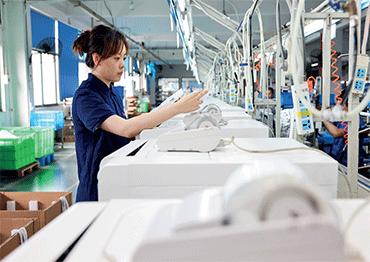
Xu Yi, who has a master’s degree in biomedical engineering from a Canadian university, conducts quality control at a medical equipment manufacturing company in her hometown of Ningbo, Zhejiang Province, June 7, 2023 (Photo by Xinhua)

Print