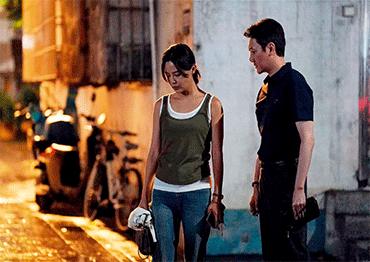
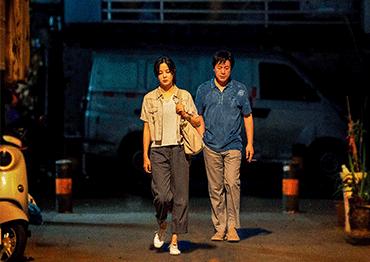
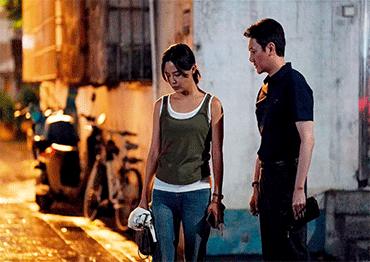
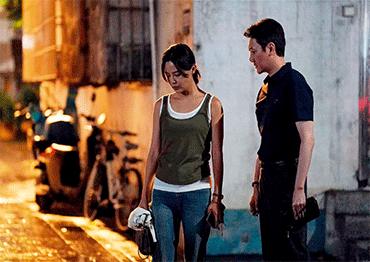
One of the film’s defining features is its emphasis on the textures of real life. All scenes were shot in real locations rather than on constructed sets.
The hospital scenes were filmed in hospitals in Guangzhou and Shaoguan, Guangdong Province. Although the crew were only permitted to shoot at midnight, working in real hospitals provided immersive details for actors that are difficult to recreate on a sound stage, such as the pungent smell of disinfectant.
“Every detail in real settings not only bears traces of real life but also carries the energy of real emotions,” Cai said. “Even the aura of ‘sickness’ that permeates a hospital influences the actors’ performances.”
Rather than requiring extensive rehearsals, Cai emphasized actors’ spontaneous responses in natural settings. Throughout filming, he insisted on using natural light for most scenes. “We had no intention of creating visually striking single shots,” Cai told NewsChina. “What we wanted was an overall sense of authenticity across the entire film.”
Cai’s insistence on realism dates back to People Mountain People Sea. To shoot a mine scene, Cai and his team spent a long time searching Southwest China for a suitable location. They eventually found a 300-meter-deep mine in Guizhou Province, where Cai filmed a one-minute take descending into the depths of the earth.
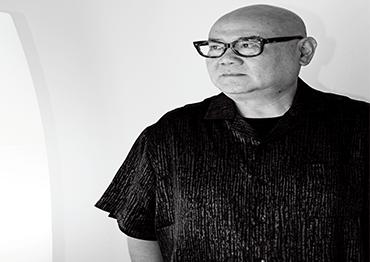
Before becoming a director, Cai worked as a screenwriter. In 1987, he was admitted to the Central Academy of Drama in Beijing, where he co-founded the drama club Honghu (The Swan) with Meng Jinghui, who became one of China’s most renowned avant-garde theater directors, and Diao Yinan, now a celebrated filmmaker and screenwriter. After graduation, Cai began his career as a professional screenwriter, penning several award-winning films including Spicy Love Soup (1999), Shower (1999) and Sunflower (2005).
Over time, Cai realized that he trusted visual images more than words as a form of self-expression. “In writing, I believe verbs and nouns are solid and believable, but adjectives and adverbs are questionable,” he said. “In images, there are no adjectives or adverbs. I often feel that words cannot fully express what I want to say, but images can. Their ambiguity, richness and depth convey meaning more effectively.”
In 2007, Cai made his directorial debut with The Red Awn, a story about a father who has worked away from his home village for years and the son he left behind. The film explores the shared predicament of China’s rural migrant workers and the emotional distance within their families.
In 2011, People Mountain People Sea, based on a real case that occurred in Guizhou Province in 2007, tells the story of Lao Tie, a man who rides a motorcycle across half of China to avenge his brother’s death. Cai did not want to tell a simple revenge story. Lao Tie’s journey exposes stark social realities, including China’s desolate villages, indifferent cities and decaying mining towns.
In The Sun Rises On Us All, Cai shifts away from broad social critique and instead delves into the psyche, particularly how people are shaped by their past. “Words we’ve said, actions we’ve taken and choices we’ve made all form who we are today,” Cai said. “If we had acted differently in the past, our fate might have been entirely different. When we look back, many seemingly minor moments turn out to be decisive turning points.”
 Old Version