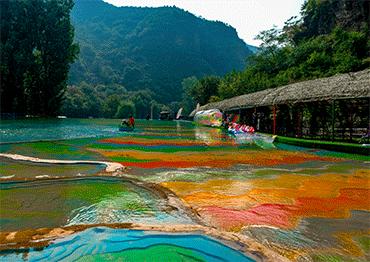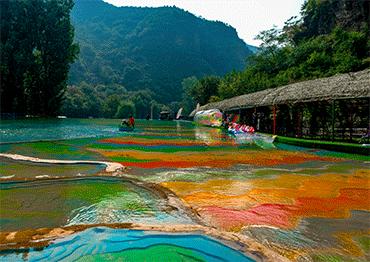
The beautiful Tianchi Lake is surrounded by mountains,Shidu Nature Park, Beijing, September 11, 2022 (Photo by VCG)
Life in Beijing can be tough. High pressure at work, high pressure for your kids to do well in school, and high pressure on all sides of your body as you squeeze into a rush hour subway car. So where can stressed out Beijingers find their refuge? Luckily for all of us, the mountains that ring the capital offer tranquility.
For many, the instinct is to go north from the city, toward the Great Wall. But unless you go in the depths of North China’s graybrown winter, you’re likely to find crowds there too. Instead, head south into Fangshan District and give Shidu a visit.
Shidu, or Tenth Crossing, gets its name from the many crossings over the winding Juma River as it gently makes its way though a valley of sheer limestone cliffs. The area starts at Yidu, or “first crossing,” and rather confusingly stretches a few dozen kilometers all the way to the 18th crossing.
While Shidu’s etymology is obvious, the name of the Juma River – which literally translates as “refusing horse” – is less obvious. There are a few historical stories, in which the river is said to have formed a barrier to invading cavalry, either through its speed or through wooden stakes driven into the riverbed by defenders. A more plausible story is that it used to have the phonetically-similar name of “giant horse” river, a reference to it supposed speed – though little of that speed remains today.
A third name for the area comes not from the river but the peaks that surround it. The startling steepness of the mountains has earned the area the nickname “Guilin of the North,” in reference to the pointed karst peaks that have made the Guangxi city a global tourist attraction.
By comparison with Guilin, Shidu is a hidden gem, though it’s far from untouched by the tourism industry. There are several scenic spots eager to sell you an entry ticket. One that’s particularly worth a visit is Gushanzhai. After you stroll through the impressive gate and pass a gaggle of honking geese, you’ll find a hiking trail up a mountain. You start off walking over dry stone riverbeds where mantises and dragonflies buzz, then you climb upwards through forests, finding stunning views of ancient rock formations and valley below. At one point, you scramble up a rocky slope and squeeze through a narrow crevice just a few feet across. Your prize for reaching the top is a cascading waterfall.
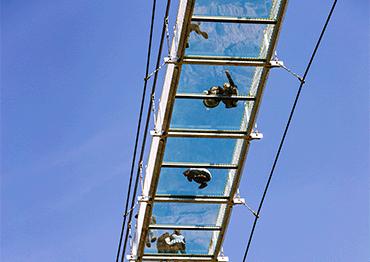
Another nearby scenic spot to soak in some natural beauty is Donghu Port. This spot offers mountain and waterfall views with a few extra flashy touches. These include a glass walkway (not for those afraid of heights), a cable car, and a raised manmade rafting section you can use to skip some of the walk down.
While Donghu Port and Gushanzhai are both relatively small – you could easily do one in the morning and the second in the evening – Yesanpo is another matter. Yesanpo scenic area isn’t technically in Shidu, indeed it’s not technically in Beijing at all, being located about an hour away just over the border in Baoding. The attraction is an almost perfect example of what modern Chinese countryside tourism can look like. Which is to say, it has kilometer after kilometer of well-maintained hiking tracks and steps, offering stunning views. You can raft down the river and enjoy the quiet flowing of the water. You can also ride in a UFO-shaped funicular to go up the mountain. As the raft passes through a cave, you’re lit up with fluorescent lights in every shade. There’s a long water ride on stilts that takes well over 10 minutes as you slide down from a mountain top to the riverside.
If you want to ramp up the flashiness all the way, you can check out Juma Paradise theme park, one of several in the area. Its claim to fame is its assertion that it was one of the first places in China to offer bungee jumping. Thrill seekers can fling themselves from one of two platforms that reach from a cliff with the river flowing below. For those who want a milder sort of thrill, the theme park offers a zipline, cliffside swings and the kind of kitschy fun you’d expect to find at a small rural theme park, for instance bumper cars.
But to be honest, while Shidu is packed with attractions, attractions aren’t really the attraction. One of the best things to do is simply to find a quiet spot along the river, find some hefty rocks suitable for perching on, and watch the Juma crawl past as the mountains loom all around. Get some snacks and drinks, maybe crack a book. Go for a paddle or a little dip, and just soak it up. Take a nap. Hope no one else sets up beside you with a Bluetooth speaker.
The area has many places to stay, mostly so-called minsu – bed and breakfast-type places usually run by a local family. One I’ve stayed in has the poetic name of Qushui Liushang, which literally means “meandering stream where cups float.” Set around a small courtyard, the rooms come with up to several bedrooms, personal outdoor hot springs baths and a patio area. In the evening, the hosts can prepare a variety of cold dishes and skewers you can barbecue yourself. There’s little better than a warm evening, some lamb on a stick, a cold beer and views of the mountains. Afterwards, you can fire up the automatic mahjong table each room comes equipped with.
As you’d expect, Shidu also has plenty of restaurants, and even a few coffee shops. There’s even a brand-new Pizza Hut, though I don’t recommend it. Most are what you’d expect from rural northern China – hearty portions and different varieties of filling pancakes to go with your rice. On our last visit we particularly enjoyed a satisfyingly crispy cornbread pancake that was perfect for mopping up leftover sauces. The local specialty is grilled rainbow trout, pulled fresh out of the Juma.
As with many places in the Beijing suburbs, while it’s theoretically possible to travel by public bus, driving yourself is a better choice, both to cut down on your journey time and to make it easier to get between the sights and your hotel. Given that so many of the attractions revolve around water, Shidu is best experienced in the warmer months from May to September. However, hiking is a year-round activity. Go for a day trip, or stay a few days.
 Old Version