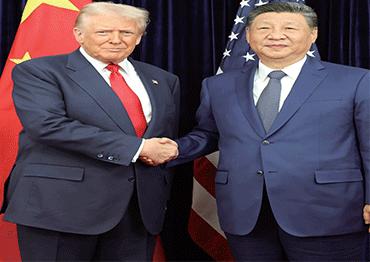
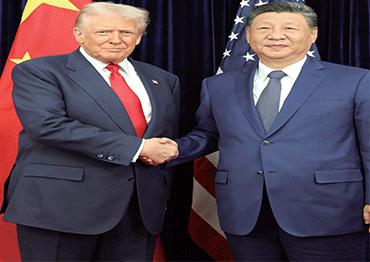
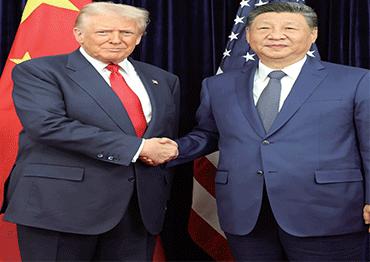
Notably, the two leaders struck a much more conciliatory tone for long-term development of the bilateral relationship before, during and after the Busan meeting. Trump told the press aboard Air Force One that he rated the talks a “12 on a scale of one to 10.”
In an interview with CBS News later on November 2, Trump said that “it is important that China and the US get along,” and that the US “can be bigger, better and stronger” by working with China.
What struck observers the most was Trump’s hailing the meeting on social media as a “G2 meeting” which he said would usher in “everlasting peace and success,” something many analysts believe suggests that the US is ready to deal with China on equal terms.
Coined by economist C. Fred Bergsten first in 2005 primarily for his proposition for a US-China joint leadership in the global economy, the G2 concept gained traction and was raised by US leaders during the 2008 global financial crisis as China’s massive stimulus helped to stabilize both its own economy and the global recovery. But China rejected this idea, arguing that it was still a developing country and would always uphold the “non-alignment” principle of its foreign policy, and that every country should have a say in global issues.
Trump’s recycling the G2 concept is thought to bear a different connotation, as much has changed since the birth of the term. The US has labeled China as a strategic rival, and China has become more assertive toward US pressure, something more evident in its effective pushbacks against Washington’s trade war in recent months.
“It[Trump’s G2 rhetoric] sent two important signals,” Wu Xinbo, a professor and dean of the Institute of International Studies at Shanghai-based Fudan University, told NewsChina. “First, with China’s countermeasures, Trump has realized that pressure and coercion are not effective tools in dealing with China. Dialogue, negotiation and mutual compromise are.”
“Second, despite persistent frictions and disputes, both China and the US are demonstrating a shared desire to stabilize the broader relationship, which is a positive development for the region and the world,” Wu added.
According to Gao Zhikai (Victor Gao), vice president of the Center for China and Globalization, a Beijing-based nongovernmental think tank, the meeting is a “turning point” in the China-US relationship.
“China considers the US neither as an enemy nor a rival, and has made its stance clear. If it’s a talk, the door is wide open. If it’s a fight, China will stand its ground to the end,” Gao said in global affairs program Cross-Strait Roundtable uploaded to YouTube on November 5.
Concluding that China and the US are now recognized as “co-equals,” Gao said that the meeting has shown that despite their disputes, the two countries will live in an “inevitable peace.” Gao first raised the idea of “inevitable peace” in 2021, arguing that a war between the two powers would be disastrous for both countries and the whole world.
China still appears reluctant to embrace the G2 idea, largely due to it suggesting a hierarchical world order, which runs counter to the underlying doctrine of China’s overall global diplomacy.
At a press conference in Beijing on October 31, while recognizing that China and the US can shoulder their responsibilities as major countries, China’s Foreign Ministry spokesperson Guo Jiakun reiterated China’s commitment to an independent foreign policy of peace, and stressed its status as the largest developing country, a partner of the Non-Aligned Movement and a member of the Global South.
“China will continue to practice true multilateralism,” he said.
 Old Version