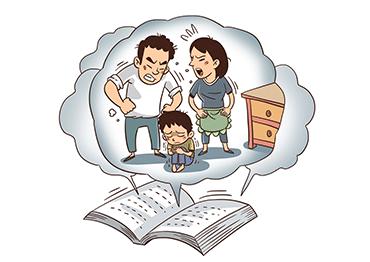
Zhou Xueguang, professor of sociology, Stanford University:“All of society has become a ‘rat race’ machine, one that involves schools, teachers, parents and students. Many children have been reduced to victims of this machine. It reminds me of the quote from Lu Xun (modern Chinese writer, 1881-1936): ‘Save the children.’ If Lu Xun once called for saving children from the repressive ethics of feudal society a century ago, then today we must save them from the frenzied chariot of meritocracy, pulled by unbridled wild horses. Source: The Paper
Xie Bing, psychologist, former Party secretary of the Shanghai Mental Health Center:“It is actually an ‘abnormal’ idea to expect every adolescent to be ‘normal,’ because puberty is naturally a turbulent stage of life. It is absolutely right to pay attention to teenagers’ mental health. But are we becoming overly anxious about it? If you treat teenagers as if they are abnormal, you will never be able to interact with them normally. We need to be more tolerant of different kinds of teenagers. It would be terrible if everyone started believing that our whole society is sick.” Source: Liang’s book release event on September 14 in Shanghai
Peng Kaiping, professor at the Department of Psychological and Cognitive Sciences, Tsinghua University:“It seems that the majority of today’s problems are being attributed to parents. But are such judgments and observations accurate? The impact of the family of origin on children is indeed very profound, yet it must be unfair to attribute all teenage problems to their families. The family of origin can influence a person’s life, but it cannot predict or determine their future.” Source: Liang’s book release event on September 23
Are Chinese parents silently driving their children to despair? A new book suggests that behind the smiles and discipline, many teens are quietly suffering.
In Let There Be Light, author Liang Hong, a professor of Chinese literature at the Renmin University of China in Beijing, explores the minds of teenagers suffering from depression and other mental health issues. However, it was Liang’s claim that teens are often “besieged” by adults, especially their parents, which has struck a nerve with the public.
Compiling three years of interviews with teenagers, their families, educators and medical experts across China, the book delves into family trauma, such as the absence of fathers both physically and emotionally, and the lack of effective, equal and honest communication.
Liang is best known for her award-winning Liangzhuang Village trilogy, which portrays a changing rural China through the lens of a small town.
According to the Report on National Mental Health Development in China (2023-2024), 30.28 percent of depression patients are under 18. The prevalence of depression among students is estimated at 10 percent in primary schools, 30 percent in middle schools and 40 percent in high schools.
Let There Be Light has sparked online discussions about parenting and the influence of the “family of origin,” a concept pioneered by the American therapist Virginia Satir. In therapy, a person’s “family of origin” refers to the household that shaped their early experiences, emotional patterns and interpersonal expectations.
On Chinese social media, this term has become widely discussed, with many users sharing personal stories of family-induced trauma during adolescence. Many argue that improper parenting is the main cause of teenagers’ mental health problems.
However, some readers note that Liang primarily attributes teenage mental health issues to parenting, while giving less attention to broader socio-economic factors, especially China’s highly competitive, exam-oriented education system and the pervasive “rat-race” culture in schools and society.
Critics also observe that blaming one’s “family of origin” has become a trend on Chinese social media. Many young people tend to hold their parents responsible for all life’s challenges, whether psychological issues, academic performance or difficulties in job seeking and marriage.
 Old Version