Old Version
History

The Crate Escape

As the Japanese army advanced on Beijing, the Palace Museum packed up its treasures for a perilous, years-long journey across southern China, ensuring the survival of a collection that now defines its centennial celebration

By Lü Weitao , Zhang Shu Updated Dec.1

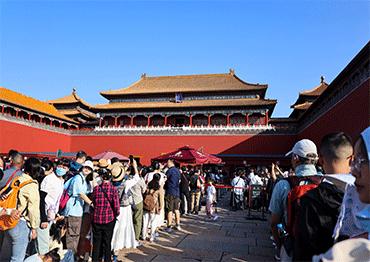
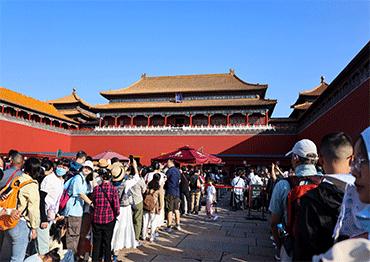
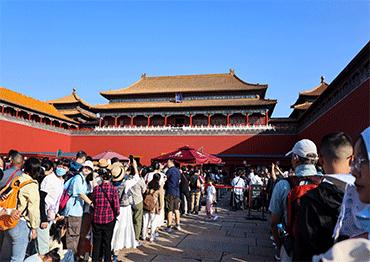
Visitors line up for an exhibition marking the Palace Museum’s 100th anniversary, Beijing, September 30, 2025 (Photo by VCG)

On October 10, the Palace Museum in Beijing celebrated its 100th anniversary, marking a century since its transformation from a seat of imperial power into a public institution dedicated to preserving China’s cultural legacy.  

This centennial not only celebrates the survival of an architectural marvel but also honors the enduring spirit of the nation’s artistic heritage.  

However, that survival was never guaranteed. The story of how some of China’s most prized relics endured is one of resilience, beginning just a few years after the museum’s founding amid a full-scale invasion. 

Art of War 
Following the Mukden Incident – a false flag operation in 1931 that Japan used as a pretext to launch its invasion of China, the Japanese military occupied the area of Northeast China then called Manchuria.  

Soon after, they set their sights on Beijing, particularly the vast collection of priceless cultural artifacts housed at the Palace Museum, a huge complex located in the heart of the city and former home to Chinese emperors known as the Forbidden City.  

Having failed in an earlier attempt to loot cultural relics during the First Sino-Japanese War of 1894, they came better prepared this time. The future of China’s most prominent museum and its vast collection hung in the balance.  

Panic spread throughout Beijing. The city’s residents were still haunted by memories of the 1860 looting and burning of Yuanmingyuan, or the Old Summer Palace, by Anglo-French Allied Forces during the Second Opium War.A tough decision had to be made: Should the Palace Museum’s collection be evacuated?  

The museum’s board of directors convened urgently to discuss the feasibility of such a plan, but no consensus was reached. It was Ma Heng, deputy director of the museum’s antiquities section, who proposed an immediate evacuation of the collection to southern China. He emphasized that the priority was to protect the relics from falling into enemy hands, even if it meant the future return of these treasures to Beijing would be uncertain.  

Ma’s proposal sparked public outcry. Critics accused him of valuing objects over the well-being of people and the nation. Among the detractors were prominent figures like Hu Shi, a renowned diplomat and scholar, and Lu Xun, a prestigious writer and literary critic. In a poem, Lu Xun lamented, “The capital stands deserted, a hollow, lonely shell, while in frantic haste, the antique treasures were shipped away.” Even Ma’s son, Ma Yanxiang, believed the relics should be sacrificed, if necessary.  

Others organized protests. Zhou Zhaoxiang, the head of the Institute of Antiquity Conservation, banded together with other commercial and civil organizations in an effort to reverse the decision. They argued that moving the relics would be too risky, and that by evacuating the collection, Beijing would be surrendering without a fight.  

As expected, Japan declared its intention to seize the Palace Museum’s collection, claiming that the Kuomintang government was no longer capable of safeguarding the relics. Japan also promoted the “Greater East Asia Co-Prosperity Sphere” and enforced the inclusion of Japanese history and language in schools under its control. Culture thus became a focal point of the war. 

At this critical juncture, Ma Heng consulted with the museum’s president, Yi Peiji. Together, they telegraphed the Kuomintang central government, then based in Nanjing, briefing the country’s leaders on the urgent situation.  

While awaiting a response, Ma Heng and Yi Peiji decided to act. They instructed museum staff to begin packing each item with the utmost care, ensuring none would be left behind when the inevitable war reached Beijing.  

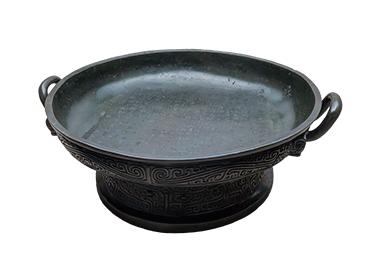
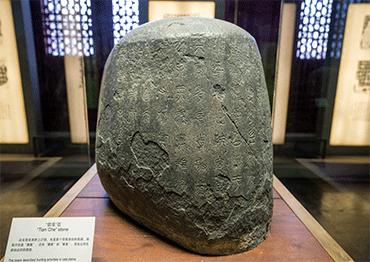
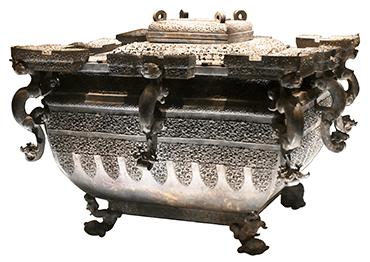
Among these treasures are the Stone Drums of Qin. A set of 10 sculptures, they bear the earliest known Chinese stone inscriptions, carved around the Spring and Autumn (770-476 BCE) and Warring States (475-222 BCE) periods. Another is the San Family Basin (Sanshi Pan), a bronze ritual artifact dating back to the Western Zhou period (around 11th-10th century BCE). The inscription on its circular plate contains one of the earliest Chinese writing systems.  

The task was not simple. The staff visited Liulichang, a cultural district in Beijing known for selling crafts, antiques and art, to learn the best methods to pack delicate artifacts.  

Back at the museum, each piece was first wrapped in cotton and enveloped in oil paper. It was then placed in a thick wooden crate, filled with cotton and straw to minimize movement during transit. The crate was finally sealed with steel wire. Several trials were conducted, including dropping the crates from certain heights, to ensure they were safe from damage.  

While some pieces were left behind due to their sheer size, like the 5.35-ton jade sculpture Yu the Great Controlling the Floods (which is still housed in the Palace Museum), ultimately a total of 13,491 crates were prepared for the largest migration of cultural relics in Chinese history.  

There was no time to waste. In early 1933, as China’s defenses crumbled and the frontlines fell, Beijing became increasingly vulnerable. The great migration of cultural relics was about to begin.

San Family Basin (Sanshi Pan), Western Zhou (1046-771 BCE), Palace Museum (Photo by VCG)

Relics on the Run 
It began on February 5, 1933. In five separate batches and escorted by Chinese armed forces, the 13,491 crates from the Palace Museum and another 6,000 crates from other institutions were loaded onto trains bound for Shanghai. Amid the deafening roar of explosions and the sound of fighter planes, all the cultural relics arrived in Shanghai safely.  

Shortly after, Ma Heng, who assumed the presidency of the Palace Museum in 1934, and his colleagues continued their journey to Nanjing, to oversee the construction of a warehouse in the renowned Chaotian Palace, one of the best-preserved Ming-era (1368-1644) architectural complexes in southern China. In 1936, the crates were on the move again, transported to Nanjing to be stored in a newly constructed warehouse.  

However, their stay in Nanjing was short-lived. The Marco Polo Bridge Incident in July 1937 near Beijing triggered full-scale war in North China. Shanghai came under heavy bombardment from Japanese invaders, and nearby Nanjing was also in grave danger.  

The dedicated team tasked with protecting China’s national treasures had no choice but to retreat. They split into three groups, each taking a different route westward from Nanjing.  

The first group, carrying 80 crates, took the southern route, ultimately reaching Anshun in the mountainous Guizhou Province in southwestern China. The second group traveled by water along the central route with 9,369 crates, arriving in Leshan in Sichuan Province. The third group moved along the northern route with 7,286 crates, eventually reaching Emeishan, also in Sichuan Province. Along the way, local people helped as much as they could, enabling the team to complete the treacherous journey.  

The first batch of 80 crates contained some of the most rare and valuable artifacts, including oracle-bone inscriptions, bronzeware, stone rubbings, calligraphy and paintings.  

On the way to Anshun, the crates were temporarily stored at Yuelu Academy in Changsha, Hunan Province. However, upon arriving in Changsha, Ma Heng realized that the academy was not a safe place for the precious artifacts. He decided to carve a cave into a nearby mountain to hide the crates. Just as the cave was completed, news arrived that the Japanese forces were approaching the city. Without delay, Ma Heng and his team loaded the crates and left. Shortly after their departure, Yuelu Academy was set on fire, a narrow escape for the irreplaceable treasures.  

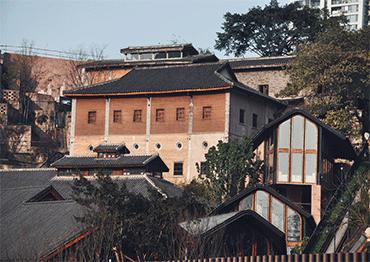
The journey along the central route was made more bearable thanks to the help of a Swedish trading house in Chongqing, Anderson & Co, which provided shelter for nearly 4,000 crates. It is said that the company flew the Swedish flag over its warehouse to deter Japanese forces, as Sweden was a neutral country during the war. The journey resumed by water, with a fleet of 11 ships transporting the crates 645 kilometers from Chongqing to Leshan.  

Upon arrival in Leshan, residents welcomed the group and offered their homes and temples to shelter the artifacts. Unfortunately, not everyone made it through the journey. While loading cargo in the early morning dim light, team member Zhu Xuekan tragically slipped and fell into the deep hull of a ship, where he died.  

Along the northern route, the team faced similar hardships, especially when attempting to navigate the snow-capped Qinling Mountains. The group often had to get out of their trucks and push them manually. Adding to the misery, they suffered severe food shortages and were forced to survive on melted snow and wild plants. Despite these challenges, they reached their destination, though with fewer members than when they had set out. 

Victory Day
On August 15, 1945, the long-awaited news arrived: Japan had surrendered to the Allied Powers, ending WWII. Upon hearing the news, staff who had stayed behind at the Palace Museum under Japanese occupation burst into tears of joy.  

Over the past 14 years, their journey had covered approximately 10,000 kilometers, traversing at least 10 provinces across China.  

On October 10, 1945, in front of the Hall of Supreme Harmony in the Forbidden City, the former Imperial Japanese Army in North China formally announced its unconditional surrender to Chinese military officers and Allied representatives.  

On February 15, 1946, a special ceremony was held at the Palace Museum to honor the heroes who had protected and escorted the relics during their wartime migration. During the ceremony, the collection was returned to the museum. To everyone’s surprise, all the artifacts remained intact, such as the Stone Drums of Qin, which are now on display in the museum’s Treasure Gallery.  

However, due to the political situation at the time, some cultural relics were kept in different locations. In 1947, over 5,400 crates previously held by the Institute of Antiquity Conservation were transferred to what is now Nanjing Museum.  

Between 1948 and 1949, the Nationalist government shipped 2,900 crates to Taiwan after their defeat by the Communist Party of China. They are currently housed in the Taipei Palace Museum, including the ancient bronze Sanshi Pan.  

Beginning in 1950, it took eight years to relocate around 6,200 crates from various institutions to the Palace Museum. An additional 2,500 crates of documents were stored in China’s National Archives Administration, while 2,000 crates of cultural relics remained in Chaotian Palace.  

In June 2021, the Anderson & Co building in Chongqing was transformed into a memorial hall to commemorate this epic journey and raise public awareness of the significance of cultural relics to the nation.  

Established in 1891, Anderson & Co primarily dealt in imports and exports. The company expanded multiple times throughout the century, setting up eight buildings for offices and warehouses. During a 2017 visit to Chongqing, Shan Jixiang, then president of the Palace Museum, decided to establish a memorial museum at the location.  

It is hard to imagine what might have happened to the Palace Museum had the evacuation not taken place. In fact, a total of 2,953 crates failed to make it onto the train.  

The Japanese had melted down dozens of bronze water vats and cannons from the Palace Museum for bullet casings, while many volumes of books, imperial edicts and other printed materials were lost to the chaos of war. Among them were historical records from the Jin (907-1125) and Liao (1115-1234) dynasties.  

The evacuation efforts not only preserved priceless cultural treasures for future generations but also shaped the Palace Museum into the leading institution we know today, guiding it on its journey to becoming a symbol of China’s enduring cultural heritage.

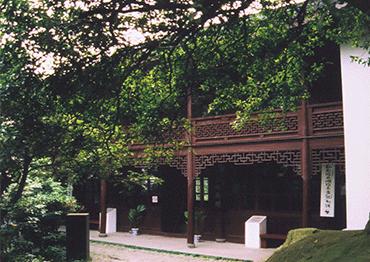
The former site of Anderson & Co, the Swedish trading house in Chongqing that sheltered nearly 4,000 crates containing cultural relics from the Palace Museum during the Japanese invasion of China. In June 2021, it was turned into a memorial hall to commemorate its role in protecting the relics (Photo by VCG)

Displayed is the Tian Che stone, one of the treasured Stone Drums of Qin, Palace Museum (Photo by VCG)

Print