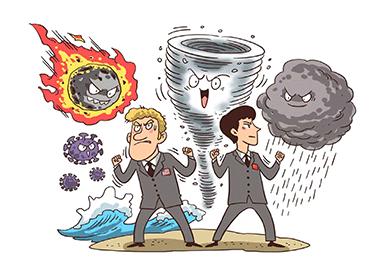
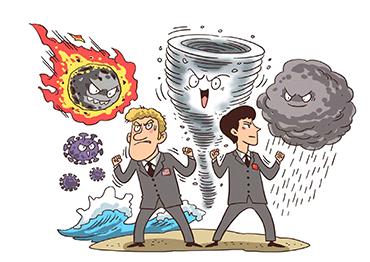
"I once spoke with American scholars and asked them when China-US relations might truly improve. They replied, ‘Only when an asteroid hits Earth.' In other words, only when a common external threat emerges will the US set aside competition. But I believe the common challenges humanity faces today, such as climate change, energy crises and public health risks, are that ‘asteroid.' These global issues are far more urgent than competition
Professor Wang Fan, deputy director of the Chinese Association of American Studies, at a July forum on area studies and global leadership hosted by the Institute of Area Studies (Chongyang Institute for Financial Studies) and the School of Global Leadership at the Renmin University of China in Beijing
"How does one explain China's competitiveness then? The answer does not lie in a single policy, but rather in the interaction of industrial organization, human capital, innovation and market scale. China now contains multiple stages of industrial development within one national market. Frontier metropolitan areas coexist with vast manufacturing networks, which creates an internal ‘flying geese' structure, moving some production to lower-cost inland regions, that spans much of the industrial value chain. Products can be designed, tested, manufactured and commercialized within a single integrated ecosystem before being deployed across a market of more than 1.4 billion people."
Guo Kai, executive president of the China Finance 40 Forum (CF40) Research Institute, arguing against a June report from the OECD claiming that China's competitiveness relies on government subsidies, in an article published on opinion piece website Project Syndicate on July 17
"Building AI models requires a long-term mindset and the ability to delay gratification, rather than using others' outputs for temporary gains in the leaderboards."
Zhang Yiming, founder of ByteDance, who said at an internal meeting in August that he would not regard distillation as a shortcut to improve AI models
"As a tool of governance, law may face competition [from new technologies], but the core capabilities of legal professionals cannot be replicated by technology. Code can solve technical problems, but it cannot address questions of legitimacy, fairness and justice. Legal professionals can make value judgments and balance interests. They also can construct rules and think in terms of long-term governance, as well as a commitment to humanistic care and protecting rights. These are boundaries that algorithms cannot cross. In this sense, the AI era does not diminish the importance of law. It instead gives law an even more important mission."
Zhang Linghan, dean of the Institute of Artificial Intelligence Law at China University of Political Science and Law, in a interview with news portal The Paper in late July
"AI outperforms humans when it comes to the left-brain but it has yet to develop the rightbrain, qualities that include empathy, aesthetics and long-term vision. This is where humans have an advantage over AI, and it has nothing to do with data."
Lee Kai-Fu, founder and CEO of Beijing-based Zero One All Things Technology, at an event promoting his new book AI: The Future Has Come at Peking University's National School of Development on August 7
"Every era has its own icons. Seeing the Forbes List rankings change neither surprises or excites me. It only makes me more vigilant. Wang Jianlin was once the icon of his era, just as I was once a young man whom everyone doubted. The cruelest part of change is that those at the top are always the last to notice it."
Justin Sun, founder of blockchain platform TRON and a prominent figure in cryptocurrency born in the 1990s, responding on X to news that he surpassed Chinese real estate mogul Wang Jianlin on the Forbes Real-Time Billionaires List on August 6, with an estimated net worth of US$8.5 billion
"Domestic animation featuring myths is now enjoying a creative boom. Animators have broken free from the stereotype that China's animation industry is still immature and have gained the ability to engage in international cultural expression. At the same time, they face fierce market competition and remain overly reliant on a small number of star IPs. While delivering stunning visual spectacles, they have yet to deepen their thematic expression. They still need to find their way out of the confused and drifting ‘Odyssey phase' and reach the ideal land of artistic expression."
Chang Fangzhou, associate researcher at the Institute of Literature, Shanghai Academy of Social Sciences, writing for The Paper's Shanghai Arts column in late July
"To this day, Chinese theoretical scientists still lag behind the world's leaders in original research. I believe one key reason is that our scientists still lack a sufficiently deep grounding in the humanities, so they have yet to fully appreciate or be deeply inspired by the truth and beauty of nature."
Renowned mathematician Shing-Tung Yau writing in the Party journal Qiushi on August 1
 Old Version